Native grass seeding is one of the most rewarding jobs in agriculture, and one of the most commonly failed. Done right, you establish a stand of warm-season natives — big bluestem, little bluestem, indiangrass, switchgrass, sideoats grama — that holds soil, feeds livestock and wildlife, weathers drought, and pays you back for decades. Done wrong, you watch a season’s work and a wagonload of expensive seed wash out, blow away, or simply never come up, and you start over the next year having learned the hard way that native grass does not forgive a sloppy job.
The difference between those two outcomes usually comes down to one thing: whether the seed actually got metered evenly, placed shallow, and pressed into firm soil. And that, in turn, comes down to your equipment. You can do everything else right — pick the perfect site, hit the perfect weather window, buy certified seed — and still fail if the machine putting that seed in the ground can’t handle what native grass seed actually is.
At Strobel Manufacturing, we’ve been building seeding and seed-handling equipment since 1946, and we built the Strobel Native Grass Seeder specifically to solve the problems that wreck native plantings. This guide walks through the whole job — what makes native seed so difficult, what a seeding rig has to do to handle it, the technique that gives a stand its best shot, and exactly what makes our seeder different from the drill sitting in most equipment sheds.
Why Native Grass Seed Is a Different Animal
If you’ve only ever planted corn, beans, wheat, or even cool-season pasture mixes, native grass seed will surprise you. It does not behave like row-crop seed, and the equipment built for row-crop seed mostly cannot handle it.
Start with the seed itself. Many of the most valuable natives produce light, chaffy, fluffy seed covered in awns, hairs, and hulls. Big bluestem and indiangrass seed looks more like a wad of lint than anything you’d expect to flow through a metering system. Little bluestem is worse. That fluff is the whole problem: it tangles, it clumps, and above all it bridges — it forms a packed arch over the seed cup or drop tube and simply stops feeding, so you drive half a field thinking you’re planting and you’re actually pulling an empty drill. By the time you notice, you’ve got a skip you can’t easily fix.
Then there’s the other half of a typical native mix. Switchgrass and sideoats grama produce slick, hard, free-flowing seed that’s almost the opposite of fluffy — small, dense, and prone to running too fast and seeding too heavy if your machine treats it like the fluffy stuff. A real native mix often carries both kinds in the same planting, which means your seeder has to meter two completely different physical seed types at the same time, at very low rates, without favoring one over the other.
On top of that, native grass seed is small and has very little stored energy to push a seedling up through soil. Bury it too deep and it never reaches daylight. Most native grasses want to be planted no deeper than a quarter inch — barely under the surface, with good seed-to-soil contact and firm ground beneath. That’s a placement tolerance measured in fractions of an inch, on uneven ground, with seed that doesn’t want to flow. And the rates are tiny: native stands are seeded in pounds of pure live seed per acre, not the bushels you’re used to, so a metering system that’s “close enough” for corn is wildly off for grass.
Finally, native grass is slow. A stand spends its first year building roots, not top growth, so it comes up thin and unimpressive while weeds race ahead of it. Producers who don’t understand that pattern plow under perfectly good stands out of impatience. Get the seeding right, though, and that slow start turns into a deep-rooted, long-lived stand that outlasts almost anything else you can plant.
Put it together and you have a planting job with almost no margin for error: difficult seed, shallow placement, low rates, firm-bed requirements, and a long fuse before you know whether it worked. That’s exactly the job the Strobel Native Grass Seeder was designed for.
The Equipment Question: What a Native Grass Rig Actually Has to Do
Before we talk about any specific machine, it’s worth spelling out the job description. A seeder that can establish native grass reliably has to do five things well, and most general-purpose equipment fails at least one of them.
First, it has to move fluffy seed without bridging. This is non-negotiable. If the metering system can’t keep light, chaffy seed flowing steadily out of the box, nothing else matters, because the seed never reaches the ground. This is where ordinary box drills and broadcast spreaders fall down — they were never built to fight the bridging that fluffy native seed creates.
Second, it has to handle slick seed at the same time. The same machine, in the same pass, needs a way to meter small, free-flowing seed at its own correct rate, separately from the fluffy seed, so your switchgrass doesn’t drown out your bluestem or vice versa.
Third, it has to place seed shallow and consistently. A quarter inch is the target. That means a seed delivery and opener system that puts seed right at the surface and into the soil — not broadcast on top to feed the birds, and not knifed down two inches deep where it dies. Minimum-till placement that works in tough, residue-covered, or untilled ground is a big advantage here.
Fourth, it has to firm the seed in. Loose, fluffy soil is the enemy of a native stand. Seed needs to be pressed into contact with moist soil and covered just enough, which calls for some means of dragging, covering, and firming behind the openers.
Fifth, it has to meter accurately at very low rates and let you calibrate. Native seedings live and die on rate. Too little and you get a thin, weedy stand; too much and you waste expensive seed and create overcrowding. The operator needs simple, repeatable control over the seeding rate and a way to verify it.
A grain drill set up for wheat won’t do most of this. A broadcast spreader does almost none of it. That gap — between what native seed demands and what general equipment delivers — is precisely the gap Strobel set out to close.
The Strobel Native Grass Seeder: Built for the Job, Point by Point
The Strobel Native Grass Seeder carries a simple promise on its nameplate: minimum maintenance, maximum performance. Underneath that is a machine engineered feature-by-feature against the five demands above. Here’s how it answers each one.
Keeping fluffy seed flowing
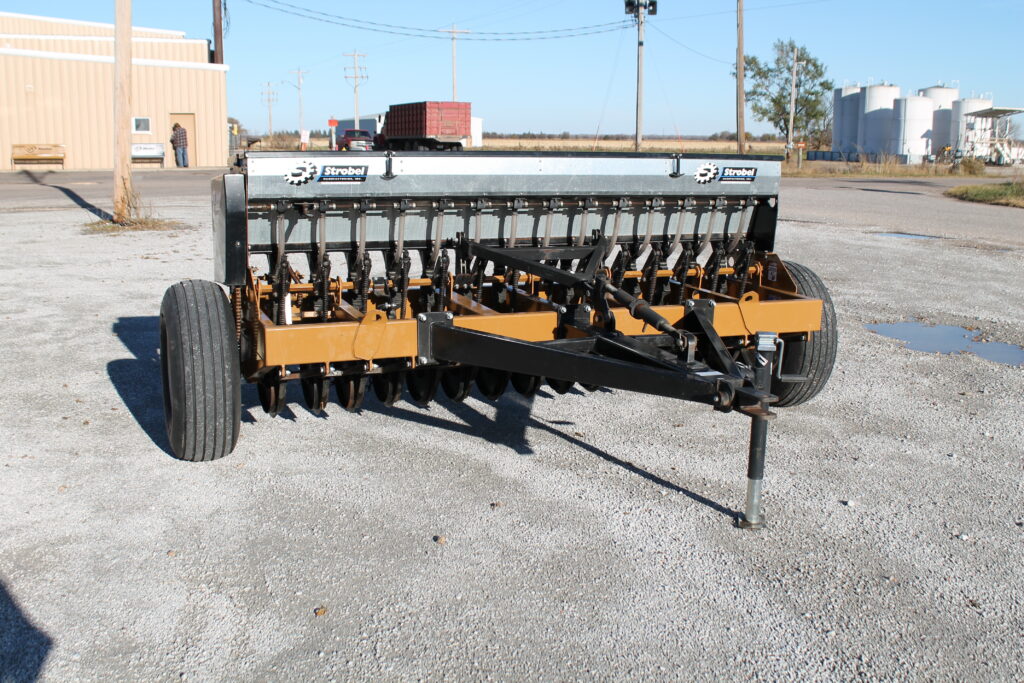
The heart of the machine is the Patented Positive Flow Paddle Agitator. This is Strobel’s answer to bridging — the single biggest reason native seedings fail at the machine. Rather than hoping gravity pulls fluffy seed down to the meter, the positive-flow paddle agitator actively keeps the seed mass moving and feeding, breaking up the arches and clumps that fluffy native seed forms before they can choke off the flow. The result is steady, even seed distribution and smooth operation across the field, not a strong start and an empty box halfway down the row. If you’ve ever fought a drill that quit feeding in the middle of a planting, you’ll understand immediately why this is the feature that matters most.
Handling two kinds of seed at once
The seeder runs both a large and a small seed box, and the roller chain drive powers both. That two-box design is the answer to the mixed-seed problem. The large box, working with the positive-flow agitator, is built to move the bulky, chaffy, fluffy native seed. The small seed box gives you separate, independent metering for fine and free-flowing seed. You’re not forcing one box to compromise between two seed types that behave nothing alike — each gets metered on its own terms, in the same pass.
Placing seed shallow, with minimum till
For getting seed into the ground at the right depth, the seeder uses an Advanced Seed Placement System paired with what Strobel built as the industry’s first all-steel seed boot. The seed boot is the business end — the component that opens the soil and delivers seed to the bottom of the slot — and building it from steel makes it tough enough for real-world, minimum-till conditions where lesser openers wear out or flex out of adjustment. Minimum-till placement matters because a lot of native seeding happens into sod, stubble, or untilled ground where you can’t or shouldn’t work the soil black first. The system is designed to set seed at that critical shallow depth dependably, pass after pass.
Covering and firming
Native seed pressed into firm soil germinates; seed lying on loose fluff does not. The seeder’s drag chains trail behind the openers to help cover seed and firm the surface, improving the seed-to-soil contact that shallow-planted native grass absolutely requires. When you’re done, the chains store neatly on the machine.
Metering accurately and calibrating
Rate control comes from an adjustable handle for flow control that lets you dial the large seed box up or down for a precise seeding rate — simple, mechanical, repeatable, the kind of adjustment you can make in the field without tools or guesswork. Add the optional acre meter and you can track exactly how much ground you’ve covered, which is how you confirm your real-world rate matches the rate you intended. For getting in and out of gear cleanly at the ends and on the move, the dog-style clutch engages and disengages the drive positively, so you’re not dribbling seed on turnarounds or fighting a slipping drive.
Built to last
All of that rides on a heavy-duty 6″ x 2″ rectangular tubular steel frame. Native seeding is rough work in rough conditions, often into untilled ground full of roots and residue, and a seeder that flexes or fatigues loses its careful seed placement. Strobel builds the frame stout on purpose, the same Strobel Strong philosophy that runs through every machine we make — from our seed handling line to our earth-moving equipment. A seeder you’ll still be running in twenty years is a far better value than one you’ll be repairing in two.
Sizes and options
The seeder comes in two row configurations: the 14 R7, with 14 rows on 7-inch spacing, and the 20 R7, with 20 rows on 7-inch spacing. The 7-inch spacing is well suited to grass stands, putting plants close enough to knit into solid cover while keeping the rows defined for even establishment. Pick the width that fits your tractor and your acreage.
From there you can spec the machine to your operation with several options: a 3-point hitch for mounted operation, the acre meter for tracking coverage, a minimum-till notched coulter with lead irons for cutting through residue and sod ahead of the openers, and a 3″ x 8″ cylinder with hose kit for hydraulic lift. That notched-coulter option in particular is worth a long look for anyone seeding into established sod or heavy residue, where clean seed slot is half the battle.
The Grass Seeder Trailer: One-Person Loading, Built to Match
A native grass seeder isn’t worth much sitting at the shop because it’s a chore to move. That’s why Strobel offers a custom grass seeder trailer purpose-built for the machine. It’s designed for safe, simple, one-person loading and unloading — a real consideration when you’re a one- or two-person outfit chasing a narrow weather window and don’t have a crew standing around to wrestle equipment.
The trailer is built with a rectangle-and-square tubing frame, a slide-out tongue with a 2-5/16″ ball coupler, a slide-out axle, nylon strap drill-wheel tie-downs, a tongue clamp and stand, greasable pivot points, and removable wheel stops, with optional lights. In plain terms: it loads the seeder low and easy, locks it down securely for the road, and gets your rig from one project to the next without a fight. Matching the trailer to the machine is the kind of detail that separates equipment built by people who actually use it from equipment built to a spec sheet.
Specifications at a Glance
| 14 Row (14 R7) | 20 Row (20 R7) | Trailer | |
|---|---|---|---|
| Row Spacing | 7 in | 7 in | — |
| Overall Height | 4′ 5″ | 5′ 3″ | 3′ |
| Overall Length | 7′ 3″ | 7′ 3″ | 20′ 7″ |
| Overall Width | 10′ 6″ | 14′ 4″ | 7′ |
| Frame | 6″ x 2″ tubular steel | 6″ x 2″ tubular steel | Rectangle & square tubing |
Both seeder models share the same core: the positive-flow paddle agitator, the large and small seed boxes, the roller-chain drive, the all-steel seed boot, the dog-style clutch, and the adjustable flow-control handle. You’re choosing width, not capability. Full details and the current options list are on the Native Grass Seeder page, and you can see the machine working in the field in the video on that page.
Technique: Establishing Native Grass the Right Way
The best seeder in the country won’t save a planting that ignores the fundamentals. Native grass establishment is a system, and the machine is one part of it. Here’s the technique that gives a stand its best odds — the same principles extension agronomists and seasoned range managers have proven over decades.
Start with the seedbed
Native seedlings are weak competitors early on, so the single most important thing you can do before you ever load seed is get weeds under control and prepare a firm, clean seedbed. Whether you’re working tilled ground or seeding no-till into a killed cover or sod, the goal is the same: a surface firm enough that your boot leaves only a shallow print, free of the aggressive weeds that would otherwise smother slow-starting grass. If you’re preparing ground conventionally, a well-prepared, firmed seedbed sets up the precise shallow placement native seed needs — the kind of finish work a Strobel Row Finisher is built to deliver. A loose, cloddy, or weedy seedbed is the most common reason good seed fails.
Time it for your region
Native warm-season grasses are typically planted as a dormant seeding in late fall through winter, or as a spring seeding once soils begin to warm. Dormant seeding lets winter moisture and freeze-thaw action work the seed into contact with the soil and naturally break seed dormancy, so the stand is ready to jump when spring warmth arrives. Spring seeding works well too, especially for switchgrass and the warm-season natives, when planted into a warming, moist seedbed. The right window depends on your species mix and your local climate, so lean on your state’s NRCS office or extension specialist for the dates that fit your ground. The machine doesn’t care which window you choose — but your stand cares a great deal that you choose one and hit it.
Calibrate to pure live seed
Native seed is sold and seeded on a pure live seed basis — the percentage of the bag that is actually viable, germinable seed — not just bulk pounds. Always work your rate in PLS pounds per acre, following the recommendation for your species and purpose, and then calibrate the seeder to deliver it. This is where the adjustable flow-control handle and the optional acre meter earn their keep: set the rate, run a measured check, confirm the machine is putting out what you intended, and adjust before you commit the whole field. Ten minutes calibrating saves a season of regret.
Plant shallow and firm
Set your depth shallow — a quarter inch is the standard target for most natives, and erring toward the surface beats burying seed too deep every single time. Let the all-steel seed boot and the drag chains do their job placing and covering seed just under the surface, then make sure the ground is firmed for solid seed-to-soil contact. If you can see a little seed at the surface here and there, you’re closer to right than if it all disappeared into soft ground.
Be patient and manage weeds
This is the hardest part, and it isn’t about equipment at all. A first-year native stand spends its energy underground building roots, so it looks thin and unimpressive on top while weeds shoot up around it. Don’t panic and don’t tear it out. Manage the competition — mow weeds high to keep them from shading out the seedlings, follow the weed-control guidance for your species, and give the stand the time it needs. By the second and third year, those deep roots turn into the dense, drought-tough, long-lived stand you planted for. The producers who succeed with native grass are the ones who trust the process through that slow first year.
Where the Seeder Fits in the Bigger Picture
Native grass seeding rarely happens in isolation. It’s part of getting seed handled, hauled, prepared, and placed across a whole operation, and Strobel builds the equipment for the full chain. On the seedbed side, the Row Finisher delivers the firm, even ground that precise shallow seeding depends on. On the logistics side, our seed-handling lineup — including the Box Seed Tender, the Bulk Seed Tender, and the Skid Seed Tender — keeps seed moving safely and efficiently so your planting equipment stays in the field instead of waiting on a load. You can see the whole seed-handling range in the Strobel Seed Handling brochure. It’s the same philosophy from one end of the operation to the other: protect the seed, respect the timing, and build the equipment to last.
Common Native Seeding Mistakes — and How the Right Rig Avoids Them
After decades around this work, we see the same handful of mistakes sink plantings over and over. Most are avoidable, and several are exactly what the machine is built to prevent.
Planting too deep is the number one killer. It’s an honest mistake — folks set the openers like they would for wheat and bury small native seed where it has no chance. The fix is discipline on depth and a delivery system, like the all-steel seed boot and drag chains on the Strobel seeder, that’s designed to keep seed at that shallow quarter-inch target rather than knifing it down.
Running an uncalibrated machine is a close second. Producers eyeball a setting, plant the whole field, and only discover at the end that they ran out of seed at the halfway mark or laid it on twice as thick as planned. Calibrating against pure live seed with the adjustable flow-control handle and confirming coverage with the acre meter turns rate from a guess into a known quantity.
Fighting a seeder that bridges is the mistake that’s purely an equipment problem. If your fluffy seed keeps arching over and starving the meter, you get streaky, gap-toothed stands no matter how careful you are everywhere else. That’s the entire reason the positive-flow paddle agitator exists — to take that failure mode off the table.
Seeding into a loose or weedy bed is a preparation mistake that no seeder can overcome. Firm the ground and knock back the competition first; a Row Finisher pass on worked ground gives the seeder the surface it needs. And finally, giving up too early is the mistake that wastes a stand that actually succeeded — pulling out thin-looking first-year grass that was about to take off in year two. Trust the slow start.
The Bottom Line: Why Strobel’s Seeder Is Different
Plenty of machines will drop seed on the ground. Far fewer will reliably meter fluffy native grass seed without bridging, handle slick seed in the same pass, place it shallow into minimum-till ground, firm it in, and let you calibrate the whole thing to a precise rate — pass after pass, year after year. That short list is exactly what the Strobel Native Grass Seeder was engineered to do, and it’s why it’s a different machine than the general-purpose drill most folks try to make work.
The patented positive-flow paddle agitator beats the bridging that kills most plantings. The large and small seed boxes handle the two-headed seed problem natives create. The all-steel seed boot and advanced placement system put seed where it has to be, even in tough ground. The drag chains firm it in. The adjustable flow control, dog-style clutch, and optional acre meter give you the precise, repeatable control native seeding demands. And the 6″ x 2″ steel frame means you bought it once.
Whether you’re putting in CRP acres, restoring native range, establishing warm-season grazing, seeding pollinator habitat, or reclaiming disturbed ground, the seed is too valuable and the window too short to leave the outcome to a machine that wasn’t built for the job. Strobel has been building equipment that earns its keep since 1946, and the Native Grass Seeder carries that same standard into one of the most demanding plantings in agriculture.
If you’re planning a native seeding, talk to the people who build the machine. Contact Strobel or find your nearest rep through the dealer locator, and call (308) 548-2254 to get the right seeder set up for your ground before your planting window opens. Quality, service, and innovation — that’s been Strobel Strong since 1946, and it’s what goes in the ground behind this seeder.