In the livestock business, heat stress is a silent profit killer. It doesn’t show up on a death loss report the way a blizzard or a wreck does. It works quietly — a few pounds of feed left in the bunk here, a tenth of a pound off the daily gain there, a settled cow that didn’t settle, an open heifer you were counting on. By the time the summer’s over and you tally it up, the heat has cost you real money, and most of it never had to leave your operation in the first place.
Shade is the single most cost-effective tool you have to fight back. And at Strobel Manufacturing, we’ve spent more than fifteen years building the #1 selling livestock shade in America, learning exactly how cattle, horses, goats, and sheep use shade in the real world — not in a lab, but in feedlots and pastures from Oregon to Texas to Nebraska and everywhere in between.
The first question nearly every producer asks us is the right one: “What size do I need, and how many head will it cover?” This guide answers it. We’ll walk through all three Super Shade sizes — the 20×20, the 30×30, and the 40×40 — break down the head count for each, and give you the straight, no-nonsense math and management thinking that goes into matching the right shade to the right operation. By the time you’re done reading, you’ll know exactly which Strobel Super Shade fits your herd.
Why “How Many Head Per Shade” Is the Question That Matters
Before we get to the numbers, understand why getting this right is worth your attention.
When you don’t provide enough shade for the number of animals in a pen, you don’t solve the heat problem — you concentrate it. Cattle are herd animals, and on a hot afternoon they will all want to be in the cool spot at the same time. If the shade is undersized for the group, they bunch. They pile up shoulder to shoulder, blocking each other’s airflow, trapping body heat, churning up dust, and competing for the few square feet that actually beat the sun. The boss animals win. The timid ones, the lighter cattle, the ones already struggling — they get pushed to the edge or out into the open entirely. That’s exactly the wrong outcome, because the animals that get crowded out are usually the ones who needed the shade most.
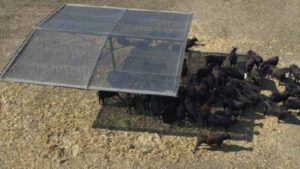
Bunching also defeats the cooling effect that makes shade work in the first place. A Strobel Super Shade can lower the ground temperature beneath it by 35 to 45 degrees compared to open, sun-baked dirt. That cooler ground is a huge part of the benefit — cattle lie down and shed heat into it. But pack too many animals onto that footprint and there’s no room to lie down, the ground heat builds back up from all those bodies, and you’ve turned a cooling station into a sweat lodge.
Properly sized shade does the opposite. It spreads the herd out, keeps airflow moving, gives every animal honest access to cooler ground, and lets cattle stay calm and stay on feed through the hottest part of the day. The payoff shows up where it counts. Strobel Super Shades have been proven to increase rate of gain by up to 20% while drastically reducing water usage — because cattle that aren’t dumping their energy into thermoregulation put that energy into pounds instead, and cattle that aren’t standing at the tank panting all afternoon don’t run your water bill into the ground.
So the head count isn’t a marketing number. It’s the difference between shade that works and shade that just looks like it should.
The Principle Behind the Numbers: Square Feet Per Head
Every head-count rating Strobel publishes comes back to one idea: usable shaded square footage per animal.
Across our three sizes, the design target lands in the neighborhood of 16 to 18 square feet of shade per head of cattle. That’s the sweet spot we’ve arrived at after years of watching real herds use real shades. It’s enough room for animals to lie down and spread out without crowding, while still keeping the structure economical and portable. Here’s how that math plays out across the lineup:
- The 20×20 delivers 400 square feet — rated for approximately 25 head of cattle (400 ÷ 25 = 16 sq ft each).
- The 30×30 delivers 900 square feet — rated for approximately 50 head of cattle or horses (900 ÷ 50 = 18 sq ft each).
- The 40×40 delivers 1,600 square feet — rated for over 100 head of cattle (1,600 ÷ 100 = 16 sq ft each).
Now, a few honest caveats, because we’d rather you size this right the first time than call us disappointed.
Those numbers describe finishing and feedlot cattle in typical management. If you’re running bigger-framed cattle, cow-calf pairs, or animals in a hotter, more humid climate, you’ll want to budget more square feet per head — many producers and extension specialists plan on 20 to 40 square feet per head for cow-calf operations and larger cattle. Smaller stock — goats, sheep, calves — pack in tighter, which is why the same 20×20 that shades 25 head of cattle will comfortably shade around 50 goats. Animal size, hide color, climate, and how you lay out your pens all move the number. We’ll cover each of those variables further down. For now, hold onto the rule of thumb — roughly 16 to 18 square feet per head of cattle — because it’s the backbone of everything that follows.
The 20×20 Super Shade: Small Herds, Sick Pens, and Specialty Stock
Don’t let the smallest footprint in the lineup fool you. The 20×20 Super Shade is built every bit as tough as its big brothers, and for a whole lot of operations, it’s exactly the right tool.
The numbers: The 20×20 covers 400 square feet and is rated for approximately 25 head of cattle or horses, or around 50 goats. It rides on a 3,000-pound concrete base — a ton and a half of purpose-built ballast that keeps it planted when the wind comes up. Total shipping weight runs about 4,000 pounds. It’s anchored by a 5″ x 5″ center post, stands 9 feet at the perimeter and 10 feet 5 inches overall, and — unlike the larger models — uses a one-piece Shur-co® 70% mesh tarp.
Who it’s for: The 20×20 is the answer for acreages, hobby herds, and small operations that don’t need to shade a hundred head but absolutely need to shade the ones they’ve got. It’s ideal for sick pens and hospital pens, where a sick or recovering animal has zero tolerance for added heat stress and needs a cool, low-stress place to recover. It’s a favorite for horse owners, for show stock, and for producers running goats, sheep, or even captive deer. If you run a handful of pairs on a few acres, or you need a dedicated shade for the doctoring pen at the corner of the yard, this is your shade.
Because it’s lighter and more compact, the 20×20 is the easiest of the three to reposition with a smaller tractor or skid steer, which makes it a natural fit for smaller equipment fleets. You get the full Strobel Strong build — the heavy base, the 70% Shur-co mesh, the eight ratchet straps, the self-storing tarp — in a package scaled to a smaller herd.
The 30×30 Super Shade: The Mid-Size Workhorse
The 30×30 is the do-everything shade — big enough to cover a serious string of cattle, manageable enough to move and place without a major production. For a lot of cow-calf operators and mid-sized yards, it hits the sweet spot.
The numbers: The 30×30 provides 900 square feet of shade and is rated to protect approximately 50 head of cattle or horses. It sits on a stout 6,000-pound concrete base — three full tons of stability — with a 7,500-pound total weight. The frame steps up to a 6″ x 6″ center post, and the structure stands tall: 12 feet 6 inches at the perimeter and 14 feet 5 inches overall. That extra height isn’t just for looks — it improves airflow and lets bigger equipment and taller animals move underneath comfortably. Like the 40×40, the 30×30 uses a two-piece 70% Shur-co mesh tarp that rolls up and stores right on the frame.
Who it’s for: This is the shade for the mid-sized cow-calf herd, the backgrounder, or the feedyard pen that runs around fifty head. It’s also a strong pick for rotational grazing operations that want meaningful coverage they can pick up and follow the herd with as they move through paddocks. Run two 30x30s in a larger pen and you’ve got a hundred head covered with the flexibility of splitting the herd’s shade into two cooling zones — which, as we’ll discuss, can actually reduce bunching compared to a single structure.
If you’re not sure between sizes and your numbers are in the 40-to-60 head range, the 30×30 is usually the smart, versatile choice. It’s the Goldilocks shade: not too small to matter, not so large it’s hard to handle.
The 40×40 Super Shade: The Feedlot Flagship
The 40×40 is the shade that built Strobel’s reputation. It’s the original, the flagship, and the one you’ll see standing in commercial feedyards across the country. When you need to cool serious numbers of cattle, this is the heavy hitter.
The numbers: The 40×40 Super Shade delivers a massive 1,600 square feet of shade and is built Strobel Strong to service over 100 head of cattle. It’s grounded by a 6,500-pound concrete base, carries a total weight of about 8,500 pounds, and is framed around a beefy 7″ x 7″ center post — the stoutest in the lineup. It stands 12 feet at the perimeter and reaches 14 feet 6 inches overall, with a two-piece 70% Shur-co mesh tarp that rolls up for winter storage. This is a structure designed to stand in an open feedlot, take whatever the weather throws at it, and keep a hundred-plus head of cattle cool and on feed all summer long.
Who it’s for: This is the commercial feedlot shade, the large-pen shade, the high-stocking-density shade. If you’re finishing cattle in numbers, the 40×40 gives you the most shaded square footage per dollar and per square foot of pen. It’s also the right answer for any operation that values maximum coverage from a single, easy-to-relocate unit. Feedyards routinely run multiple 40x40s down a pen, spacing them to spread the herd and keep airflow moving between structures. With over 1,600 square feet apiece, a handful of these shades can transform the comfort — and the performance — of an entire yard.
When ranchers tell us shade is “definitely important in our feed yard,” as the crew at HD Feeders in Hermiston, Oregon put it, the 40×40 is usually the shade they’re standing under.
Side-by-Side: The Super Shade Spec Comparison
Here’s the whole lineup at a glance, so you can match size to herd in one look:
| 20 x 20 | 30 x 30 | 40 x 40 | |
|---|---|---|---|
| Shaded Area | 400 sq ft | 900 sq ft | 1,600 sq ft |
| Head of Cattle (approx.) | ~25 | ~50 | 100+ |
| Goats (approx.) | ~50 | — | — |
| Total Weight | 4,000 lbs | 7,500 lbs | 8,500 lbs |
| Concrete Base | 3,000 lbs | 6,000 lbs | 6,500 lbs |
| Center Post | 5″ x 5″ | 6″ x 6″ | 7″ x 7″ |
| Tarp | 70% Shur-co® Mesh (1-piece) | 70% Shur-co® Mesh (2-piece) | 70% Shur-co® Mesh (2-piece) |
| Ratchet Strap Hold-Downs | 8 | 8 | 8 |
| Perimeter Height | 9′ | 12′ 6″ | 12′ |
| Overall Height | 10′ 5″ | 14′ 5″ | 14′ 6″ |
| Best For | Acreages, small herds, sick pens, horses, goats, sheep | Mid-size cow-calf, backgrounders, rotational grazing | Feedlots, large pens, high stocking density |
Notice that every size carries eight 2-inch ratchet strap hold-downs and the same exclusive 70% Shur-co® mesh tarp. That’s deliberate. We don’t cut corners on the small shade just because it’s small. Whether you’re shading 25 head or 125, you get the same wind stability, the same airflow, and the same Strobel Strong build.
How Many Head Per Shade, By Species
Cattle are the headline, but the Super Shade earns its keep across a barnyard’s worth of animals. Here’s how the head count shifts when you change species, because not every animal needs the same footprint.
Cattle. Plan on roughly 16 to 18 square feet per head for feedlot and finishing cattle. That puts the 20×20 at ~25 head, the 30×30 at ~50 head, and the 40×40 at over 100 head. For larger-framed cattle, bulls, or cow-calf pairs, budget more room per head — pairs in particular need extra space because the calf wants to be near the cow, and you don’t want them crowded.
Horses. Horses use shade similarly to cattle on a per-animal basis, and the 30×30 is rated for about 50 head. In practice, most horse operations are running far fewer animals and choose the 20×20 for a small band or a few using the same area, valuing the taller clearance and easy placement.
Goats and Sheep. Smaller stock pack in tighter. A single 20×20 will comfortably shade around 50 goats, making it a tremendous value for small-ruminant producers. Sheep figures run in a similar range depending on frame size and whether you’re shading ewes with lambs.
Mixed and specialty stock. Producers run Super Shades over everything from captive deer to show steers to bucking stock. The principle holds: figure your square footage, divide by the room each animal needs, and don’t crowd. When in doubt, give them more room, not less — under-shading is the one mistake that undoes all the benefit.
The Variables That Change Your Number
The ratings above are reliable starting points, but a good stockman knows the animal in front of him beats any chart. Several real-world factors will push your head-per-shade number up or down. Account for them before you order.
Climate and humidity. Heat stress is driven by the combination of temperature and humidity, often expressed as the Temperature-Humidity Index, or THI. In a hot, humid environment — think the Southeast, or a still, muggy stretch anywhere — cattle struggle to shed heat even in the shade, and they’ll crowd under it harder. In those conditions, size up or add a second shade so animals aren’t forced to bunch.
Hide color. Black and dark-hided cattle absorb substantially more solar radiation than light-hided cattle. A pen of black Angus finishers will hit the shade earlier in the day and stay under it longer than a pen of light cattle. If you’re running dark cattle, lean toward more shade per head, not less.
Animal size and stage. A 1,400-pound finished steer needs more room than a 600-pound feeder. Heavy, near-finish cattle are also the most vulnerable to heat — they carry the most internal heat load and the least tolerance. As your cattle grow through the feeding period, the same shade covers effectively fewer “comfortable” head, so size for your heaviest, most at-risk weights.
Pen layout and stocking density. A shade does its best work when cattle can actually get to it from all sides and lie down underneath. Cram a shade into a corner, block it with a fence line or a windbreak, or stock the pen so tight there’s no loafing room, and you’ll lose effective capacity. Give the structure open access and room around it.
One big shade or several smaller ones? This is one of the most useful decisions you can make. Splitting your coverage across multiple structures — say, two 30x30s instead of trying to cram everyone under one — spreads the herd into two cooling zones, cuts down on bunching, and keeps more airflow moving between animals. For large pens, several 40x40s spaced down the pen almost always outperform a single giant block of shade. The Super Shade’s portability makes this easy: you can add units and reposition them as you learn how your cattle actually use the space.
Matching the Shade to Your Operation
Let’s put it all together by operation type, because the right size is as much about how you run cattle as how many.
Commercial feedlot. Go with the 40×40 as your building block, and run as many as your pen counts require. With 1,600 square feet apiece servicing over 100 head, the 40×40 gives you the best coverage-per-dollar for high-density finishing cattle. Space multiple units down each pen to spread the herd. This is the configuration that protects gains and feed efficiency through the dog days, and it’s where most of our customers see that up-to-20% rate-of-gain advantage pay for the shade in a single season.
Cow-calf operation. The 30×30 is usually your workhorse, rated around 50 head and tall enough to handle pairs and bigger-framed cows comfortably. Remember to budget extra room for pairs. Many cow-calf producers value the 30×30’s portability for following the herd through summer pastures.
Backgrounder / grower yard. The 30×30 or the 40×40, depending on group size. Growing cattle in the 50-to-100 head range per pen are well served by stepping up to the 40×40 or running a pair of 30x30s.
Rotational grazing. Portability is the whole game here, and every Super Shade is built for it with through forklift pockets and recessed chain eyelets. Many graziers favor the 30×30 for the balance of coverage and maneuverability, picking it up and leapfrogging it ahead of the herd as they rotate through paddocks. As one of our customers put it, the portable design makes it easy to move the shade right along with the herd.
Small acreage, hobby herd, or specialty stock. The 20×20 is purpose-built for you — small herds, horses, goats, sheep, and show stock. You get the full Strobel build at a footprint and price that fits a smaller operation.
Sick pens and hospital pens. Don’t overlook this. A dedicated 20×20 over your doctoring pen is one of the highest-return shades you can buy. A sick animal has no reserve to spare fighting heat, and a cool, calm recovery space gets them back on feed faster. Many larger yards run a 20×20 over the hospital pen even when their finishing pens are all 40x40s.
Why Strobel Strong Matters at Every Size
A shade is only an asset if it’s standing when the storm passes. Anyone can stretch a tarp over some posts. Building a portable shade that survives years of open-feedlot weather — high winds, driving rain, hail, snow load — is another thing entirely. That’s what “Strobel Strong” means, and it’s built into every size in the lineup.
The purpose-built concrete base. Every Super Shade is anchored by a massive concrete base — up to three-plus tons on the larger models — engineered for stability in high winds. It’s equipped with through forklift pockets and recessed chain eyelets, so you can pick the whole unit up and reposition it without disassembly. That base is the difference between a shade that stays put and a shade that becomes a sail.
The Shur-co® 70% mesh tarp. We use an exclusive 70% sunblock mesh from Shur-co®, the proven leader in tarp systems. Seventy percent isn’t an accident — it’s the engineered balance point that blocks the punishing direct solar radiation while still letting air move through. Solid roofs trap heat and dead air underneath. Our mesh breathes, which is a big part of why we can drop the ground temperature 35 to 45 degrees. It also lets a little light and rain through, so the ground under the shade stays healthier and doesn’t turn into a dead, muddy hole.
Eight 2-inch ratchet strap hold-downs. Every size — 20×20, 30×30, and 40×40 — gets eight heavy 2-inch ratchet straps that tension the tarp tight to the frame and lock it down. A loose tarp flaps, wears, and fails. A tight one rides out the wind.
Self-storing design. When shade season ends, the tarp rolls up and stores right on the frame. No hauling tarps to the shed, no finding somewhere to keep them out of the weather, no fighting to get them back on in the spring. Roll it up, fasten it, and the structure protects itself through the winter — which is a huge part of why these shades last.
You get every bit of that engineering whether you buy the smallest shade or the largest. We don’t build a “good enough” small shade. We build the same shade, sized to your herd.
Placement and Orientation: Get the Most From Your Shade
Buying the right size is most of the battle. Setting it up right finishes the job. A few field-tested pointers:
Give it open access. Place the shade where cattle can reach it from multiple sides and lie down freely underneath. Don’t wedge it against a continuous fence line that blocks approach or kills airflow.
Mind the airflow. Orient and space your shades so prevailing summer breezes move through the structure, not against a wall of equipment or buildings. Airflow is half of how shade cools.
Account for the moving sun. The shaded footprint moves through the day as the sun travels. That’s fine — cattle follow it — but make sure the swing of the shadow stays inside usable pen space and doesn’t drift onto a fence or out of reach.
Spread multiple units. If you’re running more than one shade in a pen, space them apart to create separate loafing zones and keep cattle from piling into one spot. Distributed shade beats concentrated shade nearly every time.
Keep the footprint drained. Set shades where water won’t pond underneath. Cattle want cool, dry ground to lie on, not a mud wallow.
The Bottom Line: Protect Your Investment, Increase Your Rate of Gain
Here’s the honest summary. The 20×20 shades about 25 head of cattle (or 50 goats) and is your answer for small herds, horses, specialty stock, and sick pens. The 30×30 shades about 50 head and is the versatile mid-size workhorse for cow-calf herds and rotational grazing. The 40×40 shades over 100 head and is the feedlot flagship for serious numbers. Plan on roughly 16 to 18 square feet per head of cattle, size up for big-framed cattle, pairs, dark hides, and hot-humid country, and when you’re between sizes, give your animals the extra room — they’ll pay you back for it.
Because that’s the whole point. Shade isn’t an expense; it’s an investment that returns itself. Cattle under a Super Shade stay on feed, gain better — up to 20% better — drink less water, breed back stronger, and come through the summer in shape to perform. The heat doesn’t have to quietly bleed money out of your operation. You can stop it, and you can do it with equipment built to outlast the cattle standing under it.
Strobel Manufacturing has been building quality, serving customers, and innovating since 1946 — and for the last fifteen-plus years, we’ve put that same backbone into the #1 selling livestock shade in America. Super Shades are sold direct to the customer, so you deal straight with the people who build them.
If you need shade, you want Strobel. Call (308) 548-2254 and let’s get the right size headed to your operation before the heat shows up.