Every operation runs on a calendar it did not choose. The combine finishes when the crop says it finishes, the first hard freeze comes when it comes, and between those two dates sits the shortest working window of the year. For most farms, ranches, and feedlots across the Corn Belt and the Plains, that gap is a handful of weeks in late October and November. It is the last chance to touch dirt, fix a pen, or put seed in the ground before the year closes out and everything left undone gets carried into a spring that will not have room for it either.
Strobel Manufacturing has spent close to eight decades in Clarks, Nebraska watching producers run out of fall. Since 1946, the family operation has built equipment for exactly the stretches of the year when the weather stops cooperating and the margin gets thin. The summer problems are the visible ones, heat on the herd and water standing in the low end of the field. The fall problems are quieter and, in their way, more expensive, because a fall job skipped does not cost you this season. It costs you the next one, and it usually costs you with interest.
This is a look at the work that has to happen before freeze-up, the equipment that does it, and an honest accounting of where the timing actually matters versus where the calendar is more forgiving than the marketing suggests.
The Window Between the Combine and the Freeze
Start with the constraint, because the constraint is the whole argument. In spring the ground is wet and the planter owns every available hour. Through the growing season the crop is in the way. Winter is frozen solid or buried. That leaves two practical dirt-work windows a year, and the second one opens the moment the last field is cut and closes when the frost line drops past the blade.
The fall window is narrower than the summer window, and it is narrower than most operations plan for. Harvest overruns. Rain sets in. A week of ideal working conditions disappears into a grain cart problem, and suddenly it is December. The producers who consistently get fall work done are not the ones with more time. They are the ones who decided in September what the short list was and had the equipment sitting in the yard ready to go, rather than calling a custom operator in the exact three weeks every other operation in the county is calling the same man.
That last point is worth sitting with. Hired dirt work is expensive by the hour, and the contractor is least available precisely when conditions are best, because conditions are best for everyone at once. An operation that owns its scraper and grader attacks the work the day the ground is right. An operation that does not owns a place in line.
Mud Is a Fall Decision, Not a Winter Problem
Ask a cattle feeder about mud and you will get a February answer. Ask an agricultural engineer and you will get an October one, because by the time a pen is a mud hole, every decision that created it was made months earlier.
The cost is not subtle. Extension guidance widely used for feedlot performance projections scales gain loss directly to mud depth: roughly a 7 percent reduction in gain at dew claw deep, 14 percent at shin deep, 21 percent below the hock, and 28 percent at hock deep. The Alberta Feedlot Management guide, cited in Clemson’s mud management publication, puts cattle standing in four to eight inches of mud at an 8 to 15 percent drop in feed intake and a 14 percent drop in daily gain, with hock-deep conditions of twelve to twenty-four inches driving intake down 30 percent and daily gain down 25 percent. University of Minnesota Extension, drawing on fifteen years of steer data across three states, reports muddy pens accounting for 25 to 37 percent declines in daily gain and 20 to 33 percent declines in efficiency.
Those are not storm-event numbers. That is ordinary winter in a pen that was not shaped before the ground froze.
There is one more finding worth pulling out, because it reframes the whole problem. In a three-year California study, muddy pens cut average daily gain by 35.5 percent compared with clean concrete, but the loss fell to 12 percent in muddy pens where cattle had somewhere dry to stand. The animals chose that dry footing 73 percent of the observed time. Cattle are not failing to perform because mud exists. They are failing because there is nowhere in the pen to get out of it, and whether there is somewhere dry to stand is a question of grade, drainage, and mounding. All three are fall work.
The fundamentals are well established and unglamorous. Pen slopes in the range of 3 to 6 percent, feeding aprons sloped about an inch per foot, and drainage ditches kept genuinely open rather than nominally open. Manure allowed to build along a fence line stops being manure and starts being a dam, impounding water in the pen behind it. And steep lots create their own hazard, because a slope that sheds water in November is an ice slide in January when cattle have to walk it to reach the bunk.
Shaping that grade is what the Strobel Pro Grader is built for. It offers tilt, angle, lift, roll, and side shift, which matters in a feedlot because the machine has to reshape a pen surface, clean an alley, and crown a lot road in the same afternoon without going back to the shop between jobs. For moving the volume of material a rebuild requires, Strobel box scrapers run from a 6-foot light-duty model up to a 20-foot heavy-duty machine, built with reinforced solid welded sidewalls for exactly the kind of abrasive, packed, manure-laden material that destroys lighter equipment.
The pens that empty this fall are the ones to work on. They will not be empty again until they are full of frozen ruts.
The Dirt You Move Now Is the Dirt That Stays
Away from the lot, the fall list is a drainage list. The blown-out terrace, the waterway silted in from a June rain, the dead furrow that drowned out an acre and a half of beans, the field road that ruts every time it is wet. These are visible all season and fixable only now, with the crop off and the residue down.
Standing water is not cosmetic. It is lost acres, and lost acres compound every year the grade goes uncorrected. The fix is always the same in principle: shave the high ground, carry it to the low ground, and place it precisely.
Fall soil makes the placement part harder. Moisture means carryback, and dirt that sticks in the bowl is dirt you burned fuel to haul and then did not put anywhere. The Strobel Forced Ejection Scraper line addresses that directly with a forced ejection system that pushes material out rather than relying on gravity to dump it, producing controlled unloading with far less carryback and precise placement. The engineering behind it is built for abuse: a rigid mainframe with corrugated smooth sidewalls, an ejector gate that travels past the cutting edge for a complete clean-out, an adjustable greasable guide-roller system, anti-rotational pins for longevity, and replaceable three-piece high-strength cutting blades. Strobel positions the FE line in the gap between light pull scrapers that cannot move enough dirt and industrial movers no farm can justify owning.
In practical fall terms, the difference between a scraper that ejects cleanly and one that does not is whether a terrace rebuild finishes in October or gets abandoned in November.
The Step That Decides Whether the Work Holds
Here is the part of the fall list most operations skip, and it is the part that determines whether any of the rest of it was worth doing.
Fill that goes into winter uncompacted does not survive freeze and thaw. Water gets into loose material, expands, and works it apart from the inside. The terrace you rebuilt in October settles unevenly by April. The pad slumps. The new field road develops soft spots in exactly the places you will need to drive in the spring. The work was not wasted, but it was only half done, and the half that was skipped is the cheap half.
The Strobel Earth Packer comes in single and double drum configurations and exists for that step. Running it behind fall dirt work is the least expensive insurance on the entire list, and it is the item that gets cut first when the window gets short.
For crews moving real volume, particularly on haul roads and larger sites, Strobel’s Scraper Packer One-Pass pairs the HD 20 scraper with dual packers to combine scraping and earth packing into a single pass. The efficiency argument is fuel and cycle time. The fall argument is different and better: it is one fewer trip across ground that gets colder and wetter every week the calendar advances.
The Dormant Seeding Window, Honestly Assessed
Late fall opens a seeding window that has real advantages and a research record more mixed than most seed catalogs admit. It is worth laying out both.
The concept is straightforward. Dormant seeding puts seed in the ground after the soil has gone too cold to germinate, so it sits through winter and comes up in spring. The Tallgrass Prairie Center’s guidance is to begin dormant seeding in October or November once the four-inch soil temperature reaches 50 degrees, and Midwest practitioners often target the first of November as the practical marker. The advantages are genuine: winter delivers natural stratification that breaks down hard seed coats and improves spring germination, and the work comes off the spring calendar entirely, which for most operations is the busiest constraint they have. Warm-season natives are the safer candidates for the practice, because they need genuinely warm soil to germinate and are therefore unlikely to sprout prematurely and get caught by a freeze.
The honest counterweight is that establishment results vary by species and region. An NRCS Plant Materials study out of North Dakota concluded that additional research is needed before recommending dormant seeding outright, noting Minnesota work in which dormant seedings of little bluestem and sideoats grama established poorly compared with spring seedings. The North Dakota NRCS still recommends spring seeding, May into June, for conservation program plantings.
The sensible read is that dormant seeding is a legitimate and often excellent tool, particularly for CRP acres and pasture renovation where spreading the workload matters, but it is not a universal substitute for a spring seeding, and species selection and local extension guidance should drive the call. Anyone planning a fall seeding should confirm the approach against their own NRCS field office before buying seed.
Where the equipment matters is in seed placement, which is where native grass seedings most commonly fail regardless of season. The Strobel Native Grass Seeder is offered in 14-row and 20-row models at 7-inch spacing, with a patented positive flow paddle agitator for consistent delivery of the light, chaffy seed that bridges in ordinary boxes, an adjustable handle for precise rate control, a dog-style clutch for taking the seeder in and out of gear, and the industry’s first all-steel seed boot for minimum-till application. A heavy 6-by-2-inch tubular steel frame carries it. An acre meter and a minimum-till notched coulter with lead irons are available as options, and the purpose-built trailer is designed for safe, one-person loading and unloading, which is not a small consideration on a cold afternoon when there is nobody else in the yard.
Put the Shade Away Right, and Buy Next Summer’s Now
Two different shade jobs belong on the fall list, and only one of them is obvious.
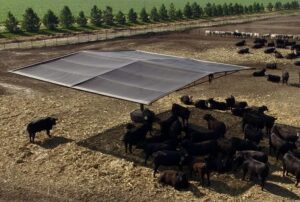
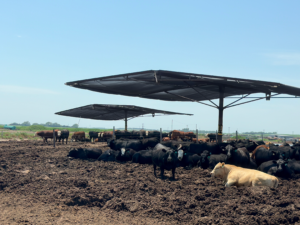
The first is winterizing. The Strobel Super Shade uses a two-piece mesh tarp designed to roll up manually and store directly on the frame through the winter, which keeps snow load off the fabric. On the 20-by-20 the tarp is a single piece. This takes a few minutes per structure and is the difference between a tarp that lasts and a tarp that gets replaced. It is also the easiest thing in this entire article to forget until the first wet snow makes the decision for you.
The second job is buying. Shade is a summer problem that gets solved in the fall, for the same reason seed handling is a spring problem solved over winter. By the time cattle are bunched and panting in July, lead time is working against you and the decision gets made under pressure. Super Shades come in three sizes: 20-by-20 for roughly 25 head, 30-by-30 for about 50 head, and 40-by-40 covering 1,600 square feet and servicing well over 100 head. The exclusive Shur-co mesh tarp blocks 70 percent of sunlight while allowing the airflow that a solid roof kills, and Strobel reports research showing ground temperature reductions of 35 to 45 degrees underneath. The frame is built around a central post of 5-by-5 to 6-by-6 inch steel depending on size, anchored on a 6,500-pound concrete base for high-wind stability, with through forklift pockets, recessed chain eyelets, and ratchet tension straps at each corner.
Super Shades are sold direct to the customer rather than through dealers, which keeps a markup out of the price and puts producers in direct contact with the people who build the structure. Fall is when that phone call is unhurried.
The Off-Season Is When Seed Handling Gets Fixed
The last item is the one nobody feels until April.
Nobody wants to discover a failing conveyor bearing at five in the morning on the first good planting day. Fall and winter are when a tender gets genuinely inspected, serviced, and repaired with no clock running and no planter sitting idle behind it. It is also when to be honest about whether last spring exposed a bottleneck. In modern production agriculture the planting window is razor thin, and the whole season can turn on whether seed reaches the planter fast enough to keep it moving. Every hour spent wrestling bags by hand is an hour of ideal conditions burning off, and it is punishing work besides.
Strobel’s seed handling line covers the Box Seed Tender, the BT300 gooseneck Bulk Seed Tender, and the BT200 Skid Seed Tender, engineered to move seed rapidly from tender to high-capacity planter with minimal downtime while specialized conveyors and augers protect the seed coat and preserve germination rates. The producers who are happiest with their setup in April are the ones who evaluated it the previous fall, with time to compare, price, and take delivery before the window closed.
The Through-Line: Fall Is a Bill You Pay Now or Pay Later
Step back and the fall list has a single shape. Every item on it is a job that is cheap in November and expensive or impossible in February.
Grade a pen now and cattle have dry footing all winter. Skip it and pay 14 to 28 percent of the gain, every day, until spring. Rebuild the terrace now and it holds the next rain. Skip it and lose the acres again, plus more soil. Pack the fill now and the work survives the freeze. Skip it and repair the same ground twice. Roll the tarp now and it lasts another decade. Skip it and buy a tarp. Fix the seed tender now and the planter never stops. Skip it and lose hours you cannot get back in April.
None of these are surprises. They arrive on the same schedule every year, which is exactly what makes them manageable and exactly why they get missed. The equipment that handles them is not exotic. It is a grader, a scraper, a packer, a seeder, and a tarp put away right.
What ties all of it to Strobel is a manufacturing record going back to 1946 and a design ethic aimed at the failure points cheaper equipment ignores. Clean ejection and precise placement on the scrapers. Solid welded sidewalls where the abrasion actually happens. Positive seed flow where light native seed normally bridges. Wind stability and self-storing tarps on the shade. These are not flourishes. They are the difference between equipment that survives the season it was bought for and equipment that becomes its own problem.
For a producer looking at the weeks between the combine and the freeze, the practical next step is the same across every line. Define the short list honestly, decide what genuinely has to happen before the ground goes hard, and talk to the people who build the equipment. The full lineups are at strobelmfg.com, a local dealer can be found through the Dealer Locator, and because the Super Shade is sold direct, sizing one to a specific herd and pen layout is a phone call to the factory at 308-548-2254.
The freeze is coming on schedule. The only open question is how much of this year’s work goes into the ground before it arrives.