Every operation has a season that quietly decides how the year ends. For most cattlemen, row-crop farmers, and feedlot managers across the country, that season is summer. It does not announce itself the way a spring snowstorm or a fall freeze does. It arrives slowly, a few degrees at a time, until one afternoon the herd is bunched in a corner, panting, refusing to eat, and the standing water from June’s rain is still sitting in the low end of the field where the beans should be filling out. By the time the damage is visible, it has already been paid for.
Strobel Manufacturing has spent close to eight decades watching producers fight that exact battle. Since 1946, the family operation in Clarks, Nebraska has built equipment for the parts of the year when the weather stops cooperating and the margins get thin. Three of the company’s core product families exist specifically to answer summer problems: the Super Shade livestock shade structure, the Forced Ejection Scraper and earth-moving line, and the seed-handling equipment that keeps next season’s planting window from collapsing. This is a look at the summer pressures that drive the need for all three, and an honest accounting of how Strobel’s approach stacks up against the alternatives a producer is likely to be weighing.
The Quiet Arithmetic of Heat Stress
Heat stress is the most expensive problem in the summer cattle business, and it is also the most underestimated. Producers tend to think of it as an extreme-weather event, something that happens during a three-day heat dome when animals start dropping. In reality, the losses accumulate on ordinary days that never make the news.
Cattle do not experience heat the way people do. A cow is a walking fermentation vat, generating enormous internal heat just by digesting forage, and she cannot sweat efficiently enough to shed it. Researchers measure the real risk using the Temperature-Humidity Index, or THI, which combines air temperature and relative humidity into a single number, because humidity is what actually traps heat against an animal that is already struggling to cool itself. The general guidance from beef-cattle research is that cattle can begin slipping into heat stress once conditions climb past roughly 77 degrees Fahrenheit, with the precise tipping point depending on humidity, solar radiation, wind speed, water access, and what the animal is being fed. On the THI scale, the warning zone for cattle starts well before the thermometer reads anything a person would call dangerous. Dairy animals begin losing production above a THI in the high 60s and face serious health risk in the low 70s, and while beef cattle carry a somewhat higher tolerance because of their lower metabolic rate, the principle is identical: the loss begins long before the crisis.
That is the part producers miss. By the time a steer is open-mouth panting with its neck extended, it has already spent days redirecting energy away from growth and toward simply staying alive. It has eaten less, moved less, and converted what it did eat less efficiently. Multiply that across a pen or a pasture and across the eight to twelve weeks of a typical summer, and the cost is no longer theoretical.
The scale of the national problem is staggering. A landmark study published in the Journal of Dairy Science back in 2003 estimated that heat stress drains well over a billion dollars a year from US livestock industries combined, with the dairy sector alone absorbing roughly 1.5 billion dollars of that annually. Those figures have only grown more relevant as summers have trended hotter and more humid across the cattle belt. Beef operations historically showed smaller per-head losses in that analysis, partly because beef breeding has traditionally clustered in spring rather than the hottest months, but that statistical comfort evaporates the moment you are the one watching your own finishing cattle stall out in August.
Reading the Herd Before the Thermometer Does
Because the losses start before the obvious crisis, knowing what early heat stress looks like is worth as much as any chart. The herd will tell you it is in trouble well before any animal goes down, and learning to read those signals is the cheapest management tool a producer has.
The clearest indicator is respiration. Cattle cool themselves largely by breathing, so the first sign of trouble is an elevated breathing rate, followed by visible open-mouth panting with the tongue out and the neck extended as stress deepens. Researchers actually score this on a panting scale, and a rising score across a group is an early-warning system that the THI has crossed the threshold for that herd. Behavior shifts next. Animals bunch together, crowd the water tank, refuse to lie down, and slack off on feed, since eating generates still more internal heat. Drool, slobber, and restlessness follow. Reproduction takes a hidden hit as well, with conception rates falling during and after heat events in ways that do not show up until breeding records come back disappointing months later.
The compounding nature of all this is what makes shade so valuable. An animal that spends its night recovering in cool air can tolerate the next hot day, but during a stretch of hot nights and hotter days the heat load accumulates with no chance to dissipate, and that is when death losses spike. Shade does not just help during the worst afternoon hours. It gives the herd a place to shed accumulated load every day of the stretch, which is exactly why structures that stay standing all season outperform whatever a producer can scramble to rig up once the panting starts.
What Shade Actually Returns
Here is the encouraging half of the story: heat stress is one of the few major agricultural losses that responds dramatically to a simple, affordable intervention. Shade works, and the research backing it is not vague.
The mechanism is straightforward. Direct sun loads radiant heat onto an animal on top of the ambient temperature, and a quality shade structure removes that radiant load almost entirely. Producers and manufacturers who have measured it report that the real-feel temperature underneath good shade can run as much as 30 degrees cooler than full sun. That difference is the gap between a steer that lies down and ruminates contentedly and one that stands at the water tank all afternoon burning calories it should be putting toward gain.
The production numbers follow directly from that comfort. University of Kentucky research at its animal research center found that beef cows given access to portable shade through spring and summer gained an extra 1.25 pounds per day, while their calves picked up an additional 0.41 pounds per day, compared with unshaded animals. Industry summaries of the broader body of research put the upside at up to a 7 percent improvement in average daily gain and up to a 4 percent improvement in feed efficiency for shaded cattle.
A 2023 paper in Frontiers in Veterinary Science examining feedlot economics concluded that shade alleviated heat-stress responses and translated into better feed conversion and higher daily gain, which is to say the structure pays for itself in pounds. And a 2024 Murdoch University trial on Black Angus steers in a commercial feedlot found that shaded cattle were measurably calmer, described as settled and sociable while their unshaded counterparts ran agitated and anxious, and that the shaded group thermoregulated better and gained more weight over the 70-day study.
That last point deserves emphasis because it is the one producers feel before they ever see it on a scale ticket. Cattle under shade are easier to work, easier to keep on feed, and less prone to the wrecks that come from animals crowding, bulling, and stressing in the heat. Shade is not just a welfare line item. It is a herd-management tool that lowers labor, lowers risk, and protects the genetic and feed investment already standing in the pen.
For anyone running the numbers, the math is hard to argue with. If a structure adds even a fraction of a pound of daily gain across a group of cattle over a single summer, the added weight at sale frequently covers the cost of the shade in one season, with years of service still ahead of it. Few capital purchases on a livestock operation return that quickly.
Not All Shade Is Equal
The catch is that the benefits above assume real shade, built to survive the environment it lives in. This is where a lot of producers get burned, sometimes literally watching a homemade structure fold in a July thunderstorm.
The temptation to build your own is understandable. Extension resources, including well-known designs circulated by beef networks, show how to weld a frame from heavy square tubing, stretch a roll of woven shade cloth rated to block around 80 percent of sunlight across the top, and put the whole thing on skids so it can be dragged between paddocks. Done right, a small homemade unit can cost somewhere in the neighborhood of a thousand to twelve hundred dollars in materials for a modest footprint, and for a hobby herd or a handful of horses that may be all anyone needs. But the do-it-yourself route carries real limitations.
The practical size of a safe homemade structure is small, often capped around ten by twenty feet before wind loading becomes a serious liability. The shade cloth has to come off before winter so snow load does not destroy it. And the failure mode in a summer storm is exactly when the animals need the structure most. Anyone who has rebuilt a flattened shade frame in the mud after a storm understands why a manufactured structure starts to look like the cheaper option over a five-year horizon.
This is the gap the Strobel Super Shade is built to fill, and it is worth understanding what the design is actually doing.
The Strobel Super Shade, Built Strobel Strong
The Super Shade is a freestanding, heavy-duty livestock shade structure offered in three sizes, scaled for everything from small animals and horses up to large commercial cattle operations. At the top of the range, the 40-by-40 model throws 1,600 square feet of shade, enough to comfortably service well over 100 head of cattle from a single structure. That kind of footprint is simply not achievable with a homemade frame, and it changes the economics of shading a feedlot or a large group.
The engineering choices reflect the company’s slogan, Better By Design, and they are aimed squarely at the failure points that plague cheaper shade. The Super Shade provides stability in high winds, which is the single most important attribute a summer structure can have, because summer is also storm season across most of the country. It comes equipped with forklift pockets and recessed chain eyelets, so a structure this size can actually be moved and repositioned with equipment a producer already owns, rather than being a permanent install that ends up creating a mud hole and a manure sink in one fixed spot. Sturdy tension ratchet straps lock the canopy down securely, and the reinforced rollup tarp fastens to the frame and rolls up cleanly for seasonal storage, solving the snow-load problem that forces homemade shade cloth to be torn down every fall.
Strobel sells the Super Shade direct to the customer, which keeps a dealer markup out of the equation and puts producers in direct contact with the people who build the thing. The full lineup and specifications live on the company’s Super Shade page at strobelmfg.com/super-shade-2, and because it is sold direct, the fastest way to size a structure to a specific herd and pen layout is a phone call to the factory at 308-548-2254.
How the Super Shade Compares to the Alternatives
A producer shopping for cattle shade in summer is realistically choosing among four kinds of solutions, and it is worth laying them out honestly rather than pretending Strobel is the only option on the table.
The first category is portable, mobile shade designed to be towed and repositioned constantly through a rotational grazing system. Shade Haven is the best-known name here, with a flagship model that spans 40 feet and covers around 1,200 square feet on a collapsible steel frame rated for wind gusts in the 50-mile-per-hour range, plus a smaller model for goats, sheep, and lighter herds. Powerflex offers a similar concept with its UTV-towable Advantage Portable Shade, which stretches triangular shade cloth over a 30-by-30 footprint and rolls up to move between paddocks. The genuine advantage of these systems is mobility for managed grazing, where moving shade prevents animals from camping in one spot and concentrating manure and urine into a single nutrient sink. The tradeoffs are footprint and price. A mobile unit’s coverage per structure is generally smaller than a large Super Shade, and the folding mechanisms that make portability possible add cost and add parts that can fail.
The second category is permanent architectural shade, exemplified by companies like USA Shade, which engineer and install large fabric tension structures with multi-week lead times. These are handsome, durable, and well suited to a showplace facility or a fixed feedlot footprint where the shade will never need to move. The downside is exactly that permanence, along with installation cost and the lead time required to get one designed, fabricated, and installed before the heat arrives.
The third category is research-forward fabricated shade from operations such as Hanson Companies, whose Easy Shade line leans heavily on the same university research described above and is manufactured domestically. These are credible competitors, and a thorough producer should price them alongside Strobel.
The fourth category is the homemade and shade-cloth route already discussed, which has its place for very small operations but does not scale.
The Super Shade’s position in this field is the practical middle ground that most commercial operations actually want. It delivers a large, high-capacity footprint closer to the permanent structures, while keeping the repositionability of a portable unit through its forklift pockets and chain eyelets. It is built and sold by a manufacturer with nearly 80 years of fabrication history, sold direct to keep the price honest, and engineered specifically for the high-wind, seasonal-storage realities of summer. For a producer who needs to shade a real herd rather than a handful of animals, and who wants a structure that will still be standing after the next storm rolls through, that combination is hard to beat. The honest recommendation is to define the herd size, the pen layout, and whether the shade needs to move weekly or stay put, then price a Super Shade against a mobile unit and a permanent structure on those terms. In the large-herd, occasional-reposition use case that describes most cattle operations, the Super Shade tends to win on cost per head shaded.
Summer Is Also Dirt-Work Season
Heat is the headline summer problem, but it is not the only one Strobel equipment was built to solve. The same months that bake the herd also open the only reliable window most operations get to fix the ground itself, and that is where the earth-moving line earns its keep.
Think about the calendar. In spring the fields are too wet and too busy with planting to do any serious dirt work. In fall everyone is racing harvest. Winter is frozen or buried. That leaves the stretch from early summer through late summer, after the crop is in and before it comes off, as the practical season for land leveling, drainage correction, terrace building, pond and waterway work, feedlot grading, and farm-road repair. Producers who let that window slide spend another full year living with the same problems.
The most expensive of those problems is poor drainage and standing water, and summer is precisely when it announces itself. A heavy June or July rain that should have soaked a uniform crop instead pools in the low corners and the old dead furrows, drowning out plants, breeding mosquitoes, rutting field roads, and turning the best ground on the farm into the part that yields nothing. Standing water is not a cosmetic issue. It is lost acres, and lost acres compound every single season until the grade is fixed.
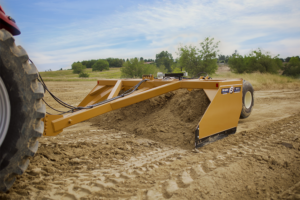
Strobel’s Forced Ejection Scraper line is engineered for exactly that fix. The FE scrapers use a forced-ejection system that pushes material out cleanly rather than relying on gravity to dump it, which means smooth, controlled unloading, far less carryback stuck in the bowl, and precise placement of the dirt where it actually needs to go. For agricultural land leveling, that precision is the whole game: the goal is to shave the high spots and carry that soil to the low spots to correct field drainage and eliminate the standing water that is costing yield. The same machine handles building durable farm roads, shaping and maintaining terraces and soil-conservation structures, and rapidly clearing and grading sites for new construction. Strobel positions the FE line to bridge the gap between light-duty pull scrapers that cannot move enough dirt and the massive industrial movers that no farm operation can justify owning, and the design details reflect serious engineering: a rigid mainframe with corrugated smooth sidewalls, an ejector gate that travels past the cutting edge for complete clean-out, an adjustable greasable guide-roller system, low-maintenance anti-rotational pins for longevity, and replaceable three-piece high-strength cutting blades. The full specifications are detailed at strobelmfg.com/forced-ejection-scraper.
The scraper does not work alone. Strobel rounds out the earth-moving family with pull-type graders for fine finishing and road maintenance, box scrapers for grading and leveling, and earth packers for compacting the fill so a new road or pad actually holds up. A producer tackling a summer drainage project is usually moving dirt, shaping it, and packing it, and the Strobel line is built so those steps work together rather than requiring three different vendors and three different parts catalogs.
There is a quieter financial argument here too. Custom dirt work hired out by the hour is expensive, and the contractor is rarely available exactly when the field is dry and ready. An operation that owns its own scraper and grader can attack the drainage problem the moment conditions allow, fix it on its own schedule, and keep that capability on hand for the next project. For larger farms and for the dirt contractors who serve them, owning the right scraper is the difference between chasing the weather window and controlling it.
Don’t Let the Summer Lull Cost You the Spring
The third summer pressure is the one nobody feels until it is too late, and it concerns the planting window that opens next spring. Summer is the natural time to take stock of how the last planting season actually went, and for a great many operations the honest answer is that the planter spent too much time sitting still, waiting on seed.
In modern production agriculture the planting window is razor thin, and the whole season can hinge on whether seed reaches the planter fast enough to keep it moving. Every hour a planter sits idle while someone wrestles bags by hand is an hour of ideal planting conditions burning away, and it is physically punishing work on top of being slow. Strobel’s seed-handling line, which spans box seed tenders, bulk seed tenders, skid-mounted tenders, native grass seeders, and row finishers across sixteen tender models, exists to eliminate that bottleneck. The equipment is engineered to move seed rapidly from tender to high-capacity planter with minimal downtime, while specialized conveyors and augers protect the seed coat to preserve germination rates, and the whole system makes it practical to organize and haul multiple seed varieties efficiently across large acreage. The payoff is a planter that stays in the field and a crew that is not broken down by the end of the day.
The reason this belongs in a summer conversation is timing. The producers who are happiest with their seed-handling setup in April are the ones who evaluated and bought it during the previous summer, while there was time to research, compare, and take delivery without the pressure of a closing window. Trying to fix a seed-logistics problem in the middle of planting is like trying to buy shade during a heat wave. The lineup is laid out at strobelmfg.com/seed-handling, and summer is the right time to walk the numbers, not next spring.
The Through-Line: Equipment for the Seasons That Decide the Year
Step back from the individual products and a single philosophy connects all three. Heat stress, standing water, and a stalled planter are not random misfortunes. They are predictable seasonal pressures that arrive on roughly the same schedule every year, and they each have the same effect, which is to quietly skim profit off an operation before the producer ever sees it coming. The Super Shade protects the pounds of gain that summer heat would otherwise erase. The Forced Ejection Scraper and the earth-moving line reclaim the acres that poor drainage drowns out. The seed handlers protect the planting window that determines the whole crop year.
What ties them to Strobel specifically is a manufacturing record that goes back to 1946 and a design ethic aimed at the failure points cheaper alternatives ignore. Wind stability and seasonal storage on the shade. Clean ejection and precise placement on the scrapers. Seed-coat protection and speed on the tenders. These are not marketing flourishes. They are the specific differences between equipment that survives the season it was bought for and equipment that becomes a problem of its own.
For a producer weighing the summer ahead, the practical next step is the same across all three lines. Define the problem honestly, whether that is head count to shade, acres to drain, or seed to move, and then talk to the people who build the equipment. Because the Super Shade is sold direct, and because sizing any of these products correctly depends on the specifics of a given operation, the most useful move is a direct conversation with the factory at 308-548-2254 or a walk through the product pages at strobelmfg.com. The heat and the rain are coming regardless. The only real question is whether the operation meets them with the right equipment already in the yard, or pays for the lesson one more year.