Heat stress is one of the most expensive problems on a cattle operation precisely because it’s so easy to miss. There’s no sick pen, no obvious outbreak — just animals that eat a little less, gain a little slower, breed a little less reliably, and, in a bad stretch, die.
Shade is one of the simplest, most proven defenses against all of it. Here’s how heat stress actually works, what the research says it costs, and how the right shade structure protects both your bottom line and your animals’ welfare.
What Heat Stress Actually Is
Cattle generate a lot of internal heat just by being cattle. Rumen fermentation — the process of digesting feed — produces significant metabolic heat. On a cool day, an animal sheds that heat easily. On a hot, humid, sunny day with no breeze and no shade an animal retains all that heat.
When an animal can’t release heat fast enough, its body shifts into survival mode. Energy that would normally go toward growth, weight gain, milk production, and reproduction gets redirected toward simply cooling down — panting, sweating, and standing instead of resting. The animal also eats less, because digesting feed would only generate more heat it can’t get rid of. Less intake plus diverted energy equals lost performance on every hot day.
That’s the core of it: heat stress doesn’t just make cattle uncomfortable. It reroutes the energy you’re paying to put into pounds and pregnancies into the work of staying alive.
How to Know When Your Cattle Are at Risk
The standard tool for gauging heat stress risk is the Temperature-Humidity Index (THI), which combines air temperature and humidity into a single number. Researchers widely use these general categories for feedlot cattle:
- THI 72 or below — no stress
- THI 72 to 78 — mild stress
- THI 78 to 88 — severe stress
- THI above 88 — very severe stress
Humidity is the part that catches people off guard. Because cattle shed heat partly through respiration. High humidity blunts that cooling — which means even a moderate temperature can become dangerous once the humidity climbs. Add direct solar radiation, still air, warm nights that don’t let animals recover, and recent rain raising humidity and risk stacks up fast.
Watch the animals. Bunching, heavy or open-mouth panting, drooling, refusing feed, and crowding into any available shade or water are all signs your herd is fighting the heat. Heavier, finished cattle and certain genetics (dark-hided breeds among them) are especially vulnerable and deserve priority.
What Heat Stress Costs
The economics are sobering, and they’re well documented across decades of animal-science research.
A foundational study by St-Pierre and colleagues estimated that heat stress costs U.S. animal agriculture somewhere between $1.69 and $2.36 billion per year, with the beef industry’s share around $370 million annually. More recent industry estimates of losses specific to finishing cattle land in the same neighborhood. Some studies estimate the cost of heat stress on the beef industry are up to $500 million annually.
What’s striking is where those losses come from. It’s tempting to assume death loss is the biggest cost, but for most operations it isn’t. The larger, quieter drain is reduced feed intake and lost performance across the whole herd — losses that researchers estimate can run several times higher than the cost of the animals actually lost to heat.
At the pen level, the numbers get more concrete. Feedlot models have estimated that an unmitigated heat season can cost well over $25 per head in lost gain and death loss — which across a single pen adds up to thousands of dollars. A cross a full yard, this could easily reach six figures. Every one of those dollars is money paid to feed for and didn’t get back.
The Welfare Side — Which Is Also the Business Side
Beyond the spreadsheet, heat stress is fundamentally an animal welfare issue. An animal panting in the sun with nowhere to escape the radiant load is suffering, plainly. Reducing that suffering is the right thing to do — and increasingly, it’s what buyers, packers, and the public expect of responsible cattle operations.
The good news is that welfare and profitability point the same direction here. Comfortable cattle that can thermoregulate, rest, and eat normally are also the cattle that gain, breed, and finish the way they’re supposed to. Protecting welfare is protecting performance.
How Shade Helps — and Where It Helps Most
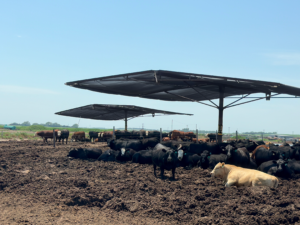
Shade works by cutting the single biggest heat load on an animal standing in an open pen: direct solar radiation. A good shade structure dramatically reduces the radiant heat hitting the animal and lowers ground and surface temperatures underneath it, giving cattle a place to escape the sun and recover.
The research backs this up with an important nuance.
In hot, humid, and high-solar environments, the performance benefits of shade are clear and often substantial. Studies have documented average daily gain improvements up to 20%. When adequate shade is provided, along with better feed efficiency and improved carcass measures. One commercial-scale analysis found advanced shade increased profitability by roughly $30 per head versus no shade, with cattle finishing more than 20 kilograms heavier. Several studies report shade structures paying for themselves within one to two years.
The practical takeaway: the hotter and more humid your conditions, the bigger the performance payoff from shade. Everywhere, shade improves welfare and protects animals against the extreme heat events that cause the most dangerous losses. Shade is both an everyday performance tool during in the hottest parts of country and an insurance policy against the worst days everywhere.
What Good Cattle Shade Looks Like
Not all shade is equal. To actually protect your herd, a shade structure needs to:
- Block a high percentage of solar radiation while letting hot air escape upward, so it cools rather than traps heat. The Strobel Super Shade 70% of solar radiation while allowing hot escape.
- Get the right size so every animal can use it. Undersized shade causes cattle to bunch underneath which concentrates heat and manure…defeating the purpose. Plan adequate shaded square footage per head.
- Stand up to a rubbing and wind. The Strobel Shade is engineered for an 80 mph wind load and built to take the rubbing and leaning cattle deliver.
- Be portable. Rotate it to fresh ground, move it off churned-up mud and manure and reposition it with your grazing or pen layout.
This is exactly what the Strobel Super Shade is built to do. It’s a heavy-duty, portable shade structure available in three sizes — 20′ x 20′, 30′ x 30′ and 40′ x 40′ — for cattle, horses, goats, sheep and other animals. The Strobel Shades is sold direct from the factory ensuring an return on your investment when protecting your livestock.
Set It Up Before You Need It
The time to put up shade is before the first heat event, not during one. A few practical pointers:
- Position for the shadow, not the structure — orient the shade so the shade pattern falls where you want cattle to gather, and where they can still catch a breeze.
- Keep water close but not underneath — heat-stressed cattle drink dramatically more, so easy water access is critical, but placing it directly under the shade just creates mud.
- Spread it out for big herds — multiple shade structures across a pen reduce bunching better than one large one.
- Rotate it — moving portable shade keeps the ground beneath it from turning into a manure-packed mud hole.
Protect the Gains You’re Paying For
Every hot day without shade is a day your cattle may be quietly trading weight gain, fertility, and welfare for the work of staying cool. Shade is one of the most cost-effective investments you can make to protect all three in hot, humid country, it’s one that frequently pays for itself in a season or two.
The #1 Selling Cattle and Livestock shade in the United States, Strobel has been building and perfecting shade for over a decade. Others may imitate, but the Strobel Super Shade is truly Better by Design.
Ready to Protect Your Herd?
Tell us your herd size, animal type, and location, and we’ll help you size the right Super Shade — and quote it factory-direct.
[See the Super Shade Lineup] · [Read the Sizing Guide] · Call our Super Shade team at (PHONE 308-548-2254)
Sources & Further Reading
- St-Pierre, Cobanov & Schnitkey — economic losses from heat stress by U.S. livestock industries (Journal of Dairy Science)
- “The Impact of Heat Load on Cattle” — review of heat stress economics and physiology (Animals, MDPI)
- University extension and industry analyses of feedlot heat stress economics (per-head and per-yard loss models)
- Peer-reviewed feedlot shade trials documenting ADG, efficiency, profitability, and welfare outcomes across climates (Journal of Animal Science; Animal; Asian-Australasian Journal of Animal Sciences; and others)