There’s a step in earthwork that too many operators skip, and it’s the one that decides whether the job holds up or falls apart. You can run the best scraper made, shape a field or a terrace dead-on grade, and walk away proud of the work — and then watch the first hard rain undo all of it, because the dirt you moved was never packed. Loose dirt is unfinished dirt. It settles, it slumps, it washes, and it ruts, and every one of those failures costs you a return trip with the equipment you thought you were done with.
Compaction is the difference between moving soil and placing soil. Grading and terracing rearrange the ground; packing turns that rearranged ground into a stable, load-bearing, water-shedding foundation that stays where you put it. It is the cheapest insurance in earthwork and the most commonly neglected.
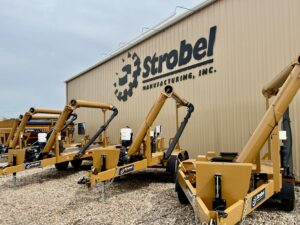
At Strobel Manufacturing, we’ve been building earth-moving equipment since 1946, and we build the Strobel Earth Packer to do exactly one thing exceptionally well: lay a firm foundation behind your scrapers and graders so the work lasts. This guide covers the whole subject — what grading and terracing leave behind, why compaction matters at the engineering level, when to pack, which packer to reach for, and how to do it right.
What Grading and Terracing Leave Behind
To understand why you pack, you have to understand what you’re packing. Any time you move dirt, you disturb its structure. Soil in undisturbed ground has settled over years into a dense, interlocked state. The moment a scraper cuts it, hauls it, and lays it down somewhere else, all of that structure is gone. The fill you place is loose, full of air voids, and “fluffed up” — it can occupy a quarter more volume than the same soil did in its natural, compacted state.
That loose condition is a liability the day it’s created. Fill that hasn’t been packed will do what gravity and water tell it to. It settles unevenly, so the smooth grade you just cut develops dips and low spots within a season. It slumps on slopes, because there’s nothing binding the loose particles together against the pull of gravity. And it erodes fast, because water runs straight into all that void space, saturates the fill, and carries it away — or worse, runs through it.
Grading a field leaves a freshly cut and filled surface that looks finished but isn’t. Terracing is more demanding still. A terrace is a soil-conservation structure — an earthen ridge and channel built across a slope to slow and redirect water and stop erosion. It is, in effect, a small dam built out of fill, and it only works if that fill is dense enough to hold its shape and resist the very water it was built to manage. An unpacked terrace is a terrace waiting to breach. The first big runoff event finds the loose, permeable fill, cuts into it, and the structure you built to stop erosion becomes a channel for it.
That’s the problem in plain terms: earthmoving creates loose soil, and loose soil doesn’t stay put. Compaction is how you fix it.
Why Compaction Matters: The Engineering Behind the Pass
Packing isn’t busywork. It changes the soil at a physical level, and every benefit you’re after traces back to one thing — driving the air out and forcing the soil particles into tight, interlocked contact. Here’s what that buys you.
Density and load-bearing capacity. Compaction increases the soil’s dry density, which is the direct measure of how much load it can carry without deforming. A packed pad under a feedlot, a building, a grain bin, or a haul road carries equipment and structures without rutting or sinking. Loose fill under that same load pumps, ruts, and fails.
Settlement control. Soil is going to consolidate to its natural dense state eventually — the only question is whether it does so under your packer, on your schedule, or on its own over the next few years in the form of dips, cracks, and uneven grade. Packing forces that settlement to happen now, uniformly, so the surface you finish is the surface you keep.
Erosion and water resistance. Dense soil has far less void space for water to enter, so it absorbs less, sheds more, and resists being carried away. On a terrace, a pond dam, or a road embankment, this is the whole ballgame.
Slope and structure stability. Compacted fill has shear strength — the internal resistance that keeps a slope from sliding and a ridge from slumping. Loose fill has very little.
Resistance to internal erosion. This one is critical for any structure that holds or directs water, like a terrace, dike, or pond dam. Water doesn’t just attack the surface; it tries to seep through the fill, and if the fill is loose and permeable, that seepage can wash out fines internally and pipe a hole straight through the structure until it fails. Proper compaction, especially with a tamping-style packer that knits the fill into a dense, low-permeability mass, is what stops that from happening.
Get compaction right and you’ve manufactured engineered fill — soil that behaves like a designed material instead of a pile of loose dirt. That’s the difference between earthwork that lasts a generation and earthwork that needs doing again next year.
When to Pack: The Situations That Demand It
The short answer is: any time you’ve placed or disturbed fill that needs to stay put or carry a load. Here are the jobs where packing isn’t optional.
After land leveling and field grading. When you cut and fill a field for drainage or irrigation, the filled areas are loose and will settle unevenly if left alone — undoing the precise grade you just established and bringing back the very low spots and standing water you were trying to eliminate. Packing the fill locks the grade in.
After building terraces. This is the headline. Terraces and other soil-conservation structures are built specifically to manage water, and they cannot do that job as loose fill. The ridge has to be compacted to hold its cross-section, resist the runoff it channels, and stand up to years of weather without slumping or breaching. Packing a terrace as you build it is the difference between a structure that protects your slope for decades and one that washes out the first wet spring.
After building ponds, dams, dikes, and levees. Anything that impounds or redirects water lives or dies on compaction. The fill must be dense and low-permeability to hold water and resist seepage and internal erosion. These structures get packed in lifts, every lift, no exceptions.
After building haul roads, feedlot pads, and building sites. A road embankment, a feedlot pen surface, a building pad, or a driveway has to carry heavy, repeated loads. Compacted subgrade and fill carry that load; loose fill ruts and potholes almost immediately. This is exactly why Strobel pairs scraping and packing for haul-road maintenance — a firm road is a road you’re not constantly repairing.
During fill placement, not just at the end. This is the rule that ties all of the above together, and it’s the one most often broken: you pack as you build, in lifts. You do not dump a four-foot fill and pack the top, because the packer can only influence so deep, and everything beneath stays loose. You place fill in shallow layers and pack each one before adding the next. We’ll come back to this in the technique section, because it’s the single most important habit in good compaction.
The Right Tool: Why a Tamping Packer
Not all compaction is the same, and not all packers do the same job. The Strobel Earth Packer is a tamping, or sheepsfoot-style, roller — a drum studded with teeth rather than a smooth cylinder — and for grading and terracing work in cohesive soils, that tooth design is exactly what you want.
Here’s why. A smooth drum compacts from the top down, pressing on the surface. A tamping drum does something better for fill: its teeth penetrate the loose lift and compact it from the bottom up, kneading the soil and driving density down into the layer rather than just sealing the surface. That kneading action is ideal for the clay and silt soils common to terraces, dams, and field fill, because cohesive soils need to be worked and remolded to reach density — pressure alone won’t do it.
The teeth do two more things that matter enormously for water-managing structures. First, they knit each new lift into the one below it. Smooth-drum compaction can leave a slick, planar seam between lifts — a built-in plane of weakness that water loves to follow. A tamping roller’s feet punch down into the lift below and bond the layers into one continuous mass with no seam to fail. Second, the packer “walks out” as the soil reaches density: when a lift is loose, the teeth sink in deep; as it compacts, the teeth ride higher, until the drum is walking on a firm surface. That gives you a built-in, visible read on when a lift is done.
Strobel built the Earth Packer to do this work harder and longer than the next machine, and the details show it. The drum carries hardened Stoodite® teeth — and 30% more of them than typical, which puts more tamping feet in the ground per revolution for superior, more uniform compaction. The teeth run in a chevron pattern that cleans on every revolution, so the drum sheds packed mud and keeps tamping smoothly instead of loading up. Behind that are clean-out blades that keep the drum scraped and working in sticky soil.
For adjustable compaction force, the drum is built to be ballasted: it holds up to roughly 1,175 gallons of liquid, which takes a single-drum unit from about 9,700 pounds empty to over 19,500 pounds filled. That nearly doubled weight lets you dial the pressure to the soil and the job — run lighter on the first passes, heavier as you build density. And it’s built Strobel Strong to take the abuse: a ½-inch industrial-strength drum with a high-strength removable cross shaft, a one-piece industrial-duty shaft running the full length of the drum, heavy-duty 2-15/16″ Timken® Type E double roller bearings, and dual-mounted cross-tube welded lift cylinders that spread the load. When it’s time to move, hydraulic lift and lock raises the drum for safe transport. The whole machine is backed by the Strobel-Strong Warranty covering parts, materials, and workmanship.
If your soil is granular — sand or gravel — or you’re after a sealed, smooth finished surface, a smooth drum is the better tool, and Strobel offers a smooth-drum option along with swivel hitch, rear hitch, and tongue options. But for the cohesive fill of fields, terraces, and water structures, the tamping drum is the right call nearly every time.
Single Drum or Double Drum: Matching the Packer to the Job
The Earth Packer comes two ways, and the choice matters more than it might seem — especially for terracing.
The single drum (SD) is one continuous 8-foot drum, 5 feet in diameter. That full-width, uninterrupted drum gives you maximum continuous coverage per pass, which makes it the efficient choice for long, relatively straight, flat work: leveling fields, building haul roads, packing large pads and building sites where you want to cover ground fast in straight lines.
The double drum (DD) splits that width into two independent 4-foot drums side by side. That split is what makes it shine on contoured and curved work. Because the two drums turn independently, the machine articulates through turns without scuffing, follows uneven and contoured ground far better, and tracks tighter curves cleanly. Terraces are, by definition, built on the contour — they curve across the slope — so the double drum’s ability to follow those curves and turn without dragging makes it the natural pick for terrace construction, pond work, and any job that isn’t a straight shot. It also packs a few more teeth, 240 versus 225, for slightly denser tooth coverage.
Here’s the full spec comparison so you can match the machine to your ground:
| Single Drum (SD) | Double Drum (DD) | |
|---|---|---|
| Number of Drums | 1 | 2 |
| Overall Length | 18′ 7″ | 20′ 1″ |
| Overall Width | 9′ 1″ | 10′ 2″ |
| Length of Each Drum | 8′ | 4′ |
| Diameter of Each Drum | 5′ | 5′ |
| Max. Ground Clearance | 12″ | 12″ |
| Number of Teeth | 225 | 240 |
| Empty Weight | 9,700 lbs | 10,020 lbs |
| Pressure per Sq In (Empty) | 240 lbs | 248 lbs |
| Weight (Filled with Water) | 19,511 lbs | 19,831 lbs |
| Total Capacity | 1,175 gal | 1,176 gal |
Both share the same Strobel-Strong build — the half-inch drum, the one-piece shaft, the Timken bearings, the Stoodite teeth, and the hydraulic lift and lock. You can see both configurations working in the field in the Earth Packer demonstration video and the photo gallery. When in doubt between the two, ask which describes your typical job: long and straight points you to the single drum; curved, contoured, and terraced points you to the double.
Technique: How to Pack Right
Owning the right packer is most of the battle. Using it correctly finishes the job. These are the fundamentals that separate compaction that holds from compaction that only looks done.
Pack in lifts. This is the rule that matters above all others. Place fill in shallow layers — generally on the order of 6 to 12 inches of loose soil per lift, depending on soil and machine — and pack each lift before placing the next. A tamping roller can only drive density so deep; pile the fill too thick and everything below the teeth’s reach stays loose, leaving a soft, hidden core in your terrace or dam that will fail later. Thin lifts, packed thoroughly, build a structure that’s dense all the way through.
Get the moisture right. Soil compacts best at a moisture content near its optimum — moist enough that the particles slip into place and bond, but not so wet that the ground pumps and won’t carry the roller. Too dry, and no amount of passes will reach target density; the soil just resists and rebounds. Too wet, and you’ll churn a mess. If a lift is bone-dry, add water; if it’s saturated, let it dry back before you pack. A simple field test — squeeze a handful; it should hold together without free water — gets you close.
Dial in the weight. Use the water ballast to match compaction force to the soil and the stage of the job. Lighter passes seat a loose lift without over-stressing it; adding water brings the machine up toward its filled weight for the heavier compaction that finishes density. The ability to adjust weight by hundreds of gallons is one of the most useful tools you have — use it.
Make enough passes, and read the walk-out. Compaction takes multiple passes per lift, not one. Watch how the drum rides: when the teeth are sinking deep, the lift is still loose; when the packer has “walked out” and is riding on a firm surface with the teeth barely marking it, that lift is done. Let the machine tell you.
Pack right behind the earthwork. Compact while the fill is fresh and at good moisture, before it dries out, crusts, or takes weather. That’s also the logic behind Strobel’s integrated scraper-and-packer approach — combining scraping and packing so fill gets placed and compacted efficiently, in close sequence, instead of leaving loose dirt sitting and losing moisture between operations.
Common Packing Mistakes — and How to Avoid Them
We see the same errors turn good earthwork into rework. Most are easy to avoid once you know to watch for them.
Packing lifts too thick is the most common and most costly. The surface looks compacted while the core stays loose, and the structure settles or fails from the inside. Keep lifts shallow.
Packing at the wrong moisture wastes every pass you make. Dry soil won’t reach density and wet soil won’t carry the roller. Check moisture before you commit the machine.
Packing only the surface — running the roller once over a deep fill and calling it done — leaves a soft body under a firm skin. Pack in lifts, from the bottom up.
Skipping compaction on terraces and water structures is the mistake that breaches dams and washes out terraces. These are the structures that least tolerate loose fill. Never leave them unpacked.
Using a smooth drum on cohesive fill leaves slick seams between lifts and can’t knead clay to density. For terraces, dams, and field fill, run the tamping drum; save the smooth drum for granular soils and finish sealing.
Not adjusting the weight means you’re either under-compacting dense soil or over-stressing a fresh lift. Use the ballast to fit the job.
Terraces and Conservation Structures: A Closer Look
Because terracing is right there in the title, it’s worth a few extra words — it’s the job where packing is least optional and most often shortchanged.
A terrace is built to intercept runoff on a slope and carry it away slowly and safely, either to a stable outlet or by soaking it in. Whether you’re building broad-base terraces a tractor can farm over, steep-backslope terraces, or the channels and ridges of a larger water-control system, the ridge is doing the work of a small dam every time it rains hard. If that ridge is loose, it doesn’t slow water — it surrenders to it. Runoff finds the permeable fill, scours into it, and what was built to stop a gully becomes the start of one.
That’s why terrace fill gets the full treatment: shallow lifts, packed every one, with a tamping drum that knits the layers together so there’s no seam for seepage to follow. The double-drum Earth Packer is the natural fit here because terraces curve across the contour, and its two independent drums follow those curves and turn through the ends without scuffing or leaving soft, skipped spots. Pay special attention to the ridge crown and the back slope, where loose fill is most exposed to weather, and pack the channel side firm enough to resist the flow it will carry.
Timing helps too. Build and pack terraces when the soil is at workable moisture — not dust-dry and not gumbo — and get them compacted and ready before your wet season arrives, so the first heavy runoff meets a finished, dense structure rather than a fresh, vulnerable one. A terrace packed right the first time is a structure you maintain occasionally for decades. A terrace left loose is a repair job you’ll be back to before the year is out, often after it’s already let a slope erode. The same logic carries to every conservation structure you build — diversions, waterways, pond dams, and dikes all live on the density you put in them.
Where the Packer Fits in the Earth-Moving Lineup
A packer doesn’t work alone — it’s the finishing step in a sequence, and Strobel builds the whole sequence. You move and place the dirt with a scraper: a Box Scraper for everyday cutting, filling, and shaping from acreage to feedlot, or a Forced Ejection Scraper for moving massive volumes with clean, controlled unloading and less carryback on big leveling and terrace jobs. For tighter or specialized work, the Dump Style Scraper handles small farms and poultry barns. Then you shape it to final grade with the Pro Grader, with its tilt, angle, lift, roll, and side-shift control. And then — this is the step you don’t skip — you lock it all in with the Earth Packer.
Scrape, grade, pack. That sequence is how loose dirt becomes a finished, durable, load-bearing surface. You can see the full range in the Strobel Earth Moving brochure and across the Earth Moving lineup, and find setup details in the product manuals.
The Bottom Line: A Firm Foundation Holds
Here’s the whole thing in a sentence: grading and terracing rearrange the soil, but only packing makes it stay. Every field you level, every terrace you build, every pad and road and pond you put in is loose, vulnerable fill until it’s compacted — and the cost of skipping that step always comes due, in settlement, ruts, slumps, and washouts that send you back with the equipment you thought you were done with.
Pack in lifts, pack at the right moisture, use the ballast to match the soil, and run a tamping drum that kneads cohesive fill into a dense, knit, water-resisting mass. For straight, flat work, reach for the single-drum Earth Packer; for the curves and contours of terraces and conservation work, the double drum follows the ground and turns clean. Either way, you’re building a foundation that holds its shape, carries its load, and sheds its water for decades — which is the entire point of doing the earthwork in the first place.
Strobel has built earth-moving equipment that earns its keep since 1946, and the Earth Packer carries that standard into the most important and most overlooked step in the job. If you’re leveling ground, shaping terraces, or building anything that has to stay put, contact Strobel or find your nearest rep through the dealer locator, and call (308) 548-2254 to get the right packer set up for your operation. Quality, service, and innovation — Strobel Strong since 1946, and the firm foundation under everything you build.