Sheep and goats face heat stress differently than cattle, and differently from each other — different coat characteristics, different browsing versus grazing behavior, and generally smaller body size that changes both sizing math and structural design needs.
This guide covers portable shade specifically for sheep and goats: how wool and hair coat affect heat and sun exposure, sizing guidance distinct from cattle, siting considerations tied to browsing behavior, and what structural differences matter for smaller livestock.
How Sheep and Goats Experience Heat Differently Than Cattle
Wool provides some insulation from heat, but not complete protection. A wool coat can offer a degree of protection from direct solar radiation, somewhat insulating skin from the sun’s direct heat even while retaining some body heat — but wool doesn’t eliminate heat stress risk, and UV radiation can still penetrate wool to a meaningful degree, meaning shade access matters for wool breeds despite the coat’s partial protective effect.
Recently shorn sheep face a distinct, temporary vulnerability window. Immediately after shearing, sheep lose both the insulating and sun-protective benefit of their wool coat until new growth provides coverage again — a period of weeks where shorn sheep are considerably more vulnerable to both sunburn and direct heat exposure than they were with a full coat, or will be again once wool regrows.
Hair sheep and goats generally handle heat differently than wool breeds. Hair sheep breeds and goats, lacking a dense wool coat, don’t face the same shearing-related vulnerability window, but also don’t get whatever partial sun-blocking benefit wool provides — meaning shade access is consistently important across the season rather than concentrated around a specific post-shearing period.
Goats are natural browsers, not grazers, and this affects shade-seeking behavior. Goats naturally seek varied terrain, brush, and browse rather than grazing uniformly across open pasture the way cattle and sheep typically do, meaning goats may already gravitate toward natural windbreaks, brush cover, and terrain features that provide some incidental shade — worth factoring into how much a constructed shade structure needs to compensate versus supplement existing natural cover.
Sizing Shade for Sheep and Goats
Sheep and goats need proportionally less space per animal than cattle, given their smaller body size, though mixed-size groups and breed variation mean sizing shouldn’t be treated as a single flat number across every operation.
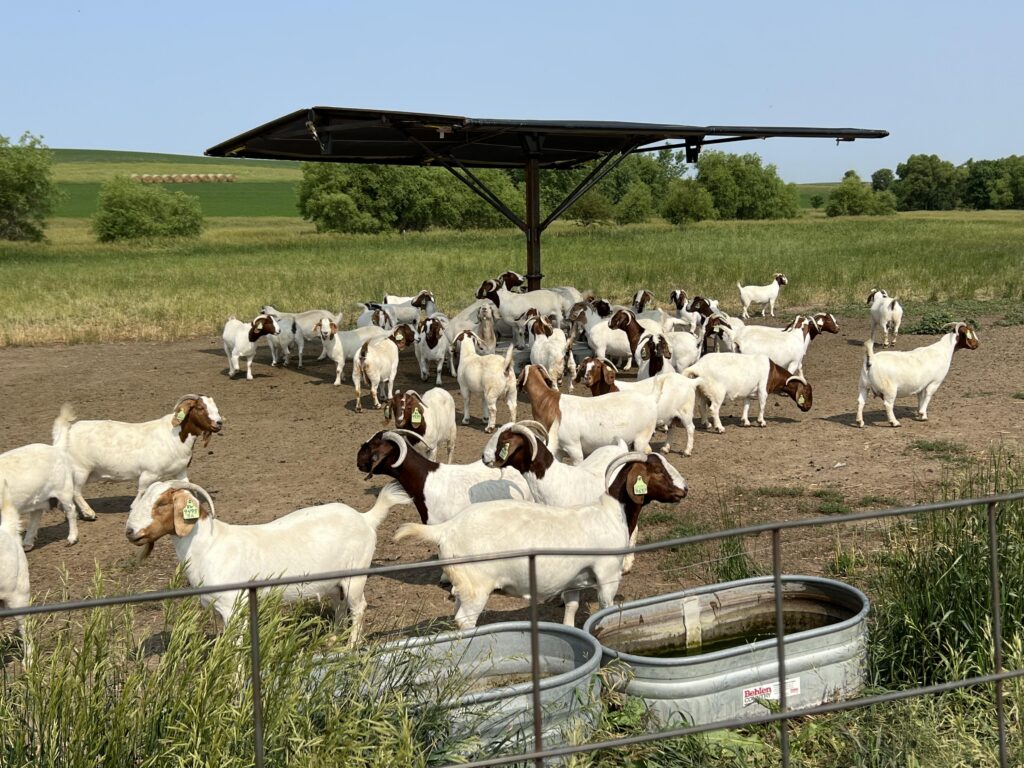
General guidance suggests considerably less square footage per head than cattle require, though specific figures vary by breed size — a large-frame meat goat breed or a large wool sheep breed needs more space than a smaller dairy goat breed or a compact hair sheep, and sizing should account for the actual breeds and body sizes present rather than a generic small-ruminant assumption. Strobel Shades come in three sizes – the 30 x 30 and 20 x 20 are perfect for sheep and goat herds. https://www.strobelshades.com
Group size and flock dynamics matter as much as raw square footage. Sheep and goats are herd and flock animals with their own social dynamics around limited resources, similar in principle to the crowding and exclusion issues documented in cattle — undersized shade concentrates dominant animals at the structure and can push more subordinate or younger animals out into direct sun, the same basic dynamic that applies across species even though the specific per-head numbers differ.
Mixed flocks of sheep and goats together should size toward whichever species or breed present has the larger typical body size, rather than averaging across the group, to avoid inadvertently undersizing for the larger animals present.
For reference against cattle sizing guidance discussed elsewhere on this site, a structure sized for 20–25 head of mature beef cattle can commonly accommodate up to roughly 50 goats or sheep of typical size on the same footprint, illustrating the substantial difference in per-head space needs between cattle and smaller ruminants.
Siting Shade for Browsing and Varied Terrain
Goats’ browsing behavior means shade siting should account for how goats actually use terrain, rather than assuming they’ll behave like cattle on open pasture. Positioning shade near existing brush lines, terrain features, or areas goats already frequent for browsing tends to see more natural, consistent use than shade placed purely based on open-field siting principles developed with cattle grazing patterns in mind.
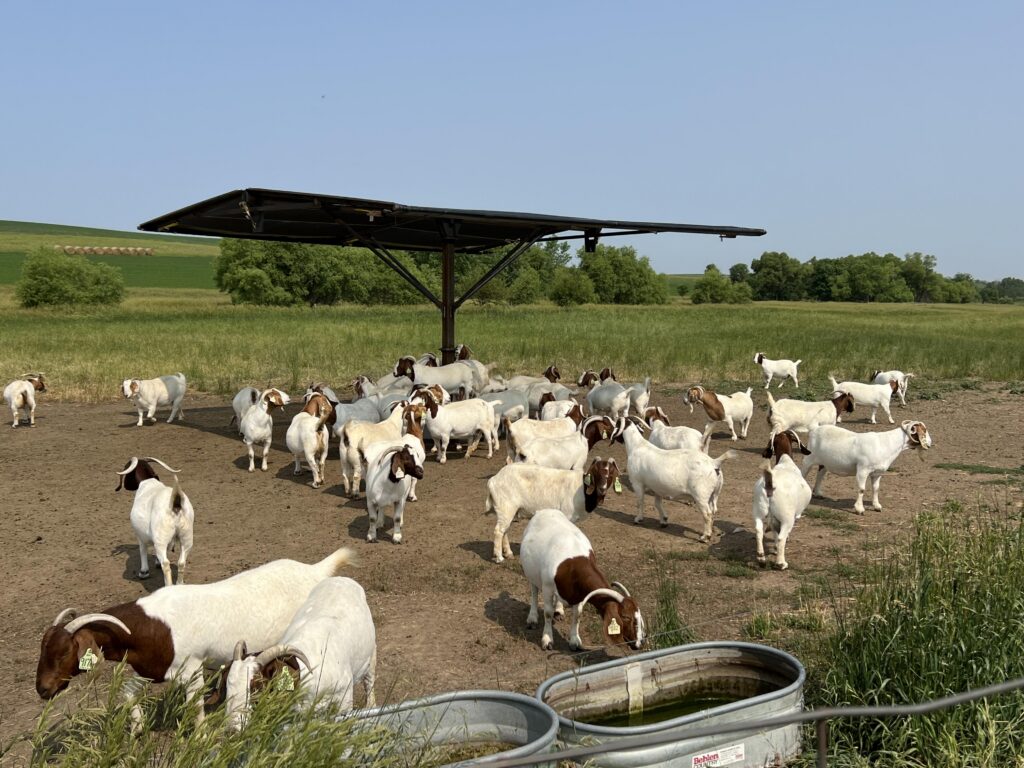
Sheep generally graze more like cattle than goats do, making standard siting principles — proximity to water, airflow, orientation — more directly applicable to sheep than the browsing-specific considerations relevant to goats.
Mixed sheep-and-goat operations may need to balance both behavioral patterns, siting shade to serve both grazing sheep and browsing goats reasonably well rather than optimizing purely for one species’ behavior at the expense of the other.
Predator protection sometimes factors into small ruminant shelter siting in ways that don’t apply the same way to cattle, given sheep and goats’ greater vulnerability to predation compared to cattle. Siting shade with some consideration for visibility and proximity to guardian animals, night housing, or other predator-management infrastructure can be a relevant secondary consideration beyond pure heat and sun management, depending on regional predator pressure.
Post-Shearing Shade Management for Wool Sheep
Given the specific vulnerability window immediately after shearing discussed above, wool sheep operations benefit from planning shade access deliberately around the shearing calendar rather than treating it purely as a general-season consideration.
Ensure adequate shade access is available immediately following shearing, ideally positioned and sized to accommodate the full recently-shorn group without the crowding and exclusion issues that undersized shade creates in any species.
Consider timing shearing to avoid the most extreme heat stretches where flock management flexibility allows, since shearing during peak summer heat compounds the sun-sensitivity of bare skin with the most intense seasonal sun exposure — though shearing timing involves other considerations (wool quality, market timing, regional practice) beyond shade planning alone.
Monitor recently shorn sheep more closely for signs of sunburn than the flock generally, particularly light-skinned or white-fleeced individuals, given the documented vulnerability of bare, previously wool-covered skin to sun damage in the weeks immediately following shearing.
Dairy Sheep and Goat Considerations
Dairy operations running sheep or goats face some of the same production-linked heat stress considerations documented in dairy cattle, worth understanding as a distinct sub-case within this broader category.
Milk production in dairy goats and sheep is sensitive to heat stress in principle similar to dairy cattle, though the research base specific to small ruminant dairy heat stress is less extensive than the cattle literature. General heat-stress principles — reduced intake leading to reduced production, the value of shade in protecting both — reasonably extend to dairy small ruminants even without the same depth of species-specific research documenting exact production impacts.
Milking schedule creates similar traffic-pattern considerations to those documented in dairy cattle. A dairy goat or sheep herd’s daily movement is anchored to milking times, meaning shade positioned along natural travel paths to and from milking, or near holding areas, likely sees more consistent use than shade placed without regard to the milking routine — the same siting logic that applies to dairy cattle.
Smaller-scale dairy small ruminant operations are common compared to large commercial dairy cattle operations, meaning shade planning often happens at a more modest scale — a home dairy goat operation or small artisanal dairy sheep flock has different infrastructure planning needs than a large commercial operation, though the underlying heat-stress and shade principles remain consistent regardless of scale.
Predator Protection and Shade Structure Placement
Beyond pure heat and sun management, small ruminant shade siting sometimes intersects with predator-management considerations in ways less relevant to cattle operations.
Sheep and goats face meaningfully higher predation risk than cattle in most regions, given their smaller size and reduced ability to defend against common predators compared to mature cattle. This can factor into shade structure siting decisions beyond pure heat-management logic.
Structures positioned with visibility and proximity to guardian animals or handlers can serve a secondary protective function beyond shade alone, particularly in regions with significant predator pressure — worth considering alongside pure heat-management siting principles rather than treating these as entirely separate planning exercises.
Night housing and shade structures sometimes serve overlapping purposes on smaller operations, where a single structure provides both daytime shade and evening predator protection — a practical efficiency worth considering for operations without the scale to justify entirely separate infrastructure for each purpose, though this requires the structure’s design and siting to reasonably serve both functions rather than optimizing purely for one.
What to Look for in Sheep and Goat Shade Structures
- Sizing appropriate to actual breed and body size present, rather than a generic small-ruminant assumption that might understate needs for larger breeds.
- Structural scale appropriate to smaller animals — a structure sized and proportioned for cattle isn’t necessarily optimal for sheep or goats, even if it technically provides adequate square footage, given differences in typical animal height and movement patterns. Often time the Strobel 20 x 20 Foot shade is a perfect solution.
- Fencing or containment compatibility, since sheep and goats — particularly goats — are notably capable of testing and escaping inadequate containment, worth considering how a shade structure’s footprint interacts with existing fencing rather than assuming a cattle-oriented structure’s containment assumptions translate directly.
- Siting that accounts for browsing behavior in goats specifically, rather than defaulting purely to open-pasture siting principles developed around cattle and sheep grazing patterns.
- Durability suited to the specific wear patterns smaller livestock create, including goats’ documented tendency to climb on and test structures in ways cattle typically don’t.
What Sheep and Goat Portable Shade Costs
Pricing generally scales with total square footage needed, and given sheep and goats’ smaller per-head space requirements compared to cattle, a structure adequately sized for a meaningful flock or herd of small ruminants often costs less than an equivalent-headcount cattle structure would, simply due to the smaller total footprint required. That said, very small, DIY-style structures built specifically for small ruminants — cattle panel arch designs covered with tarps, for instance — represent one of the lowest-cost entry points in the portable shade category generally, making this a genuinely accessible category for smaller-scale or budget-conscious small ruminant operations. Strobel Shades start at $4,250 and have an excellent return on investment.
Frequently Asked Questions
Do sheep need shade even with a full wool coat? Yes. Wool provides some protection from direct sun but doesn’t eliminate heat stress risk or sun exposure entirely, and UV radiation can still penetrate wool to a meaningful degree. Recently shorn sheep face a particularly vulnerable window until new wool growth provides coverage again.
How much space do goats and sheep need under shade? Considerably less per head than cattle, though specific figures vary by breed size — larger breeds need more space than smaller ones, and sizing should reflect the actual animals present rather than a generic small-ruminant assumption.
Do goats use shade differently than sheep or cattle? Often yes, given goats’ natural browsing behavior — goats may already gravitate toward brush, terrain features, and varied cover that provides some incidental natural shade, worth factoring into how a constructed structure’s placement complements rather than duplicates existing natural cover.
When is shade most critical for wool sheep? Immediately following shearing, when bare skin previously protected by wool is at its most sun-sensitive, until new wool growth provides renewed coverage over the following weeks.
Can the same structure serve both sheep and goats in a mixed flock? Generally yes, though sizing should account for whichever species or breed present has the larger typical body size, and siting may need to balance goats’ browsing behavior against sheep’s more cattle-like grazing pattern.
Is portable shade for sheep and goats cheaper than for cattle? Often yes on a total-cost basis, given the smaller footprint needed per animal, though this depends on total flock or herd size and the specific structure chosen.
The Bottom Line
Sheep and goats aren’t simply small cattle when it comes to shade planning — wool’s partial protective effect and the specific post-shearing vulnerability window, goats’ browsing behavior and natural terrain use, and generally smaller per-head space requirements all call for planning decisions distinct from cattle-oriented guidance. Sizing to actual breed and body size, siting with browsing behavior in mind for goats specifically, and paying particular attention to shade access immediately after shearing for wool sheep addresses the ways this category genuinely differs from cattle shade planning.
Strobel Manufacturing has built equipment for the farm and ranch since 1946. The Super Shade works well for sheep and goats in addition to cattle, horses, and llamas, with 20’x20′, 30’x30′, and 40’x40′ sizing options able to accommodate substantial flock or herd sizes given small ruminants’ lower per-head space requirements. Call (308) 548-2254 or email sales@strobelmfg.com to talk through sizing for your flock or herd.